Regional Inequality from Outer Space: Predicting GDP from Nighttime Lights and Building Inequality Indices in Python
Abstract
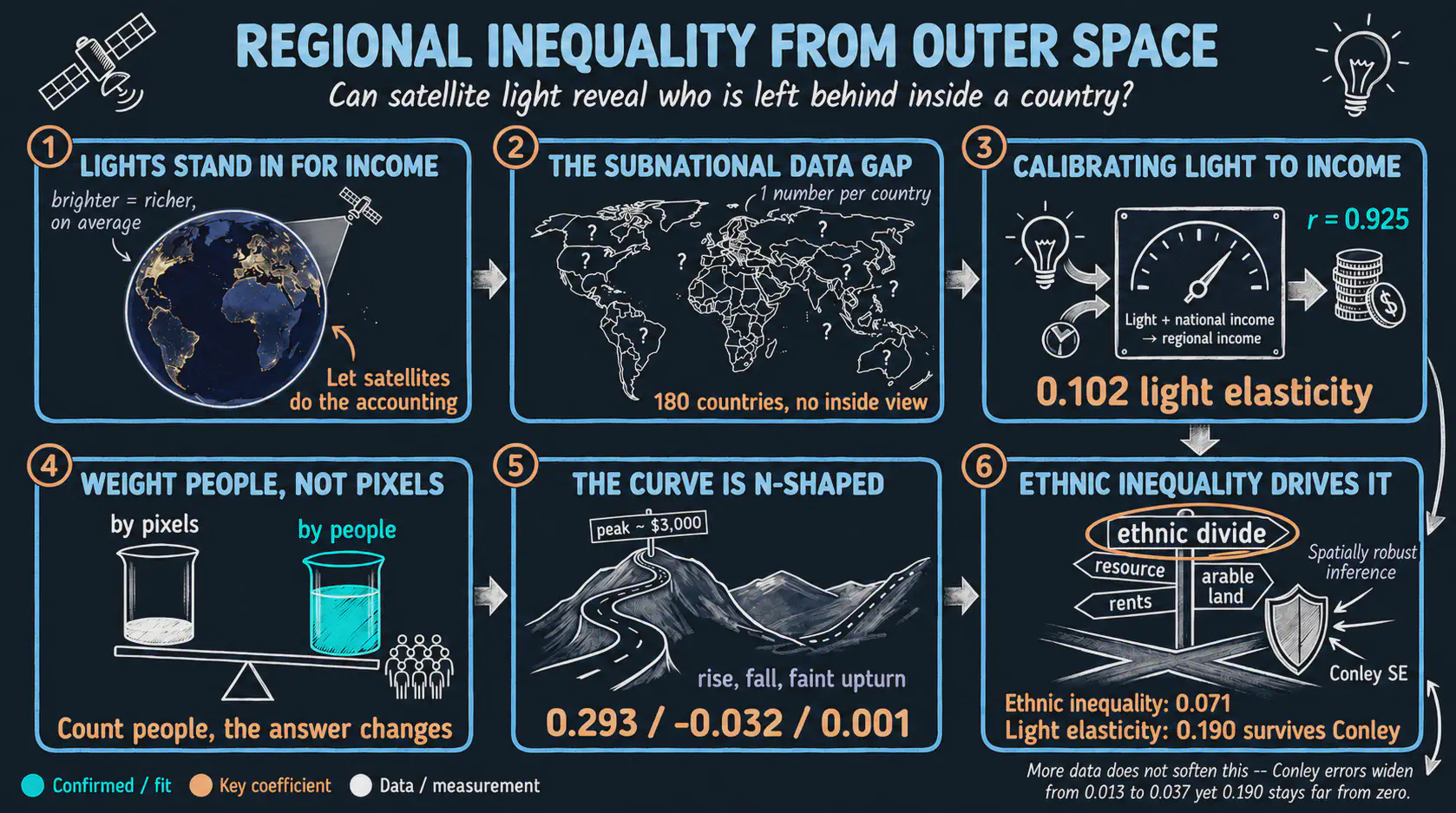
Most countries publish a single national GDP number but no income figures for their internal regions, so we cannot see whether development is shared evenly across a country’s territory. This tutorial reconstructs the measurement pipeline of Lessmann and Seidel (2017): it predicts regional GDP per capita from satellite nighttime lights, builds inequality indices from those predictions, and asks how regional inequality changes as countries grow richer. The data are a region-year panel of 5,258 subnational regions used to calibrate the lights model and a country-period panel of 180 countries spanning 1992–2012, all bundled as small CSVs. The methods are panel fixed effects in PyFixest, a random-effects sidebar in linearmodels, inequality math from first principles, and a from-scratch Conley spatial-HAC variance. The calibrated light elasticity of regional income is 0.102 and predicted income correlates 0.925 with observed income; the population-weighted regional Gini follows an N-shaped curve in development (cubic 0.293 / −0.032 / 0.001), ethnic inequality is its strongest correlate (0.071), and the light elasticity of 0.190 survives spatially-robust inference (Conley standard errors 0.026–0.037). These findings imply that nighttime lights can fill the subnational data gap well enough to study where, and for whom, growth fails to spread.
1. Overview
A government can tell you its country’s GDP, but rarely the GDP of each province inside it. That gap matters: two countries with identical national income can look completely different on the inside — one with a single booming capital surrounded by poor hinterlands, the other with broadly shared prosperity. To study that internal geography of income at a global scale, Lessmann and Seidel (2017) had a simple but powerful idea: let satellites do the accounting. Brighter places at night are, on average, richer places, so nighttime light can stand in for income where official statistics do not exist.
This post rebuilds their pipeline in Python, end to end. We start from light and a handful of controls, predict regional income, turn many regional incomes into a single inequality number per country, and finally ask the classic question: does regional inequality first rise and then fall as countries develop — the spatial version of the Kuznets curve?
The diagram below shows the four stages. The first two stages — prediction and construction — are the heart of this tutorial; they are where the data are actually made. The last two — the curve and its drivers — are familiar panel regressions, kept short here because a companion post, Regional Inequality and the Kuznets Curve: Panel Fixed Effects in Python, already explores turning points, period stability, and the full determinant analysis in depth on a pre-built inequality series.
flowchart LR
  A("Nighttime lights<br/>+ controls") --> B("Predicted regional<br/>GDP per capita<br/>(Table 1)")
  B --> C("Population-weighted<br/>inequality indices<br/>(Table 2)")
  C --> D("Regional Kuznets<br/>curve (Table 3)")
  C --> E("Determinants &<br/>robustness (Tables 4, B.4)")
    classDef blue fill:#1f2b5e,stroke:#6a9bcc,stroke-width:3px,color:#e8ecf2
    classDef orange fill:#1f2b5e,stroke:#d97757,stroke-width:3px,color:#e8ecf2
    classDef teal fill:#1f2b5e,stroke:#00d4c8,stroke-width:3px,color:#e8ecf2
    class A,B blue
    class C orange
    class D,E teal
Reading the diagram left to right, light becomes income (blue), income becomes inequality (orange), and inequality becomes the object of study (teal). Each arrow is a modelling choice we will make explicit and reproduce. By the end you will be able to defend every number on the page.
In this tutorial you will:
- Predict regional GDP per capita from nighttime lights and controls, and form the predictions explicitly.
- Construct five population-weighted inequality indices from first principles, and see exactly how population weights change the answer.
- Explore the cross-country dynamics of regional inequality across time and world regions.
- Estimate the regional Kuznets curve, its determinants, and a spatially-robust standard error using PyFixest.
- Distinguish a prediction model from a causal claim, and a fixed-effects estimate from a random-effects one.
2. Key concepts at a glance
The post reuses a small vocabulary. The definition under each term is always visible; the example and analogy sit behind clickable cards — open them when a term feels slippery.
1. Nighttime lights as an income proxy. The brightness a satellite records over a place at night, used as a stand-in for that place’s economic output. Lights correlate with income because electricity use, roads, and activity all glow. They are imperfect — deserts and oil flares mislead — which is why we predict income from light rather than equate the two.
Example
The raw correlation between a region’s nighttime brightness and its observed income is strong but noisy; turning brightness into a predicted income (Table 1) more than doubles its usefulness for measuring inequality (Gini correlation 0.49 vs 0.21).
Analogy
Like guessing a household’s wealth from its electricity bill. Useful on average, wrong for the off-grid farmer and the crypto miner, but good enough to rank neighbourhoods.
2. Light-to-GDP elasticity $\beta_1$. The percent change in predicted regional GDP per capita for a 1% change in light per pixel, holding controls fixed. It is the slope of the calibration model and the single most important number in the prediction step.
Example
In the preferred specification the elasticity is $\beta_1 = 0.102$: a 10% brighter region is predicted to be about 1% richer, once national income and geography are controlled for.
Analogy
The exchange rate between “lumens” and “dollars”. A small number, because national income already does most of the conversion; light fine-tunes the regional detail.
3. Population-weighted inequality index. A summary of how unequally income is spread across a country’s regions, where each region counts in proportion to how many people live there. The post uses the Gini, three generalized-entropy indices, and the coefficient of variation.
Example
Germany 2010, built from its 16 regions, has a population-weighted Gini of 0.028 — low, because German regions are close in income and the populous ones sit near the average.
Analogy
A class grade that weights each student by attendance. A brilliant student who shows up once barely moves the class average; the regulars set it.
4. The role of population weights. Whether each region counts once (equal weight) or by its population changes the inequality number. Weighting ties the index to where people actually live, which is the policy-relevant quantity.
Example
Across country-years the weighted and unweighted Gini correlate 0.75; weighting lowers the average Gini by about 0.003, because tiny extreme regions lose influence.
Analogy
Voting by headcount versus by district. A near-empty district and a megacity count equally in the second system; population weighting is the first.
5. The spatial Kuznets curve. The hypothesis that regional inequality rises during early development, then falls as countries converge internally — an inverted U (or, with a third act at high income, an N) in inequality against log GDP per capita.
Example
The cubic in log income has coefficients $0.293 / -0.032 / 0.001$, tracing a rise, a fall, and a faint upturn — an N-shape with country and period fixed effects.
Analogy
A country’s internal road trip: the gap between regions widens leaving the village, narrows approaching the city, and frays again in the sprawling suburbs of the very rich.
6. Conley (spatial-HAC) standard errors. Standard errors that allow nearby regions’ errors to be correlated, because a shock to one region usually spills into its neighbours. They are wider — and more honest — than the default that treats each region as independent.
Example
The light elasticity’s standard error rises from 0.013 (independent) to 0.026–0.037 (Conley, 1,000–5,000 km), but the estimate of 0.190 still sits far from zero.
Analogy
Counting independent witnesses. If ten “witnesses” all heard the same rumour, you really have one fact, not ten; Conley errors discount correlated neighbours.
3. Setup and imports
We use pandas and numpy for data work, matplotlib for figures,
PyFixest for the panel fixed-effects
regressions (its feols mirrors the R package fixest), linearmodels for the one
random-effects table PyFixest cannot estimate, and statsmodels for a convenience
regression behind one figure. PyFixest needs Python 3.10 or newer.
import numpy as np                              # arrays and math
import pandas as pd                             # data frames (tables)
import matplotlib.pyplot as plt                 # figures
import pyfixest as pf                           # fixed-effects / OLS regressions
from linearmodels.panel import RandomEffects    # the one random-effects model (Section 6)
import statsmodels.formula.api as smf           # a convenience regression (one figure)

# Site colour palette (used in every figure)
STEEL, ORANGE, INK, TEAL = "#6a9bcc", "#d97757", "#141413", "#00d4c8"
np.random.seed(42)                              # make any randomness reproducible
The site palette keeps the figures consistent: steel blue for primary data, warm orange for fitted lines and reference lines, near-black for the curves we want to stand out. With the tools loaded, we point at the data.
We load the bundled CSVs straight from GitHub so the notebook runs unchanged in Google
Colab, falling back to a local data/ folder when you run it offline.
BASE = ("https://raw.githubusercontent.com/cmg777/starter-academic-v501/"
        "master/content/post/python_kuznets_dmsp/data/")

def load(name):
    """Read a bundled CSV from GitHub, falling back to a local data/ copy."""
    try:
        return pd.read_csv(BASE + name)
    except Exception:
        return pd.read_csv("data/" + name)
The load helper means every reader — on Colab, on a laptop, online or offline — gets the
same data with no manual downloads. Next we read the files and look at their shapes.
4. The data: sources and construction
This section documents the data behind every number in the post: what each file is for, where each variable originally came from, how it was constructed, and what it looks like descriptively. Everything traces back to Lessmann and Seidel (2017). The exhaustive, column-by-column reference — construction, original source, units, and time–country coverage for all six files — lives in Appendix A; this section gives the readable tour.
4.1 Three views of the world
The replication ships three “views” of the same world. The region-year files
(Prediction_Data.csv, Table_2_data.csv, Table_B4_data.csv) describe individual
subnational regions: their lights, their observed and predicted income, their populations
and coordinates. The country-year files (Table_3_data.csv, Table_4_data.csv,
Figure_5_data.csv) describe whole countries, each already carrying the inequality indices
computed from its regions. We read all six.
# --- load all six bundled CSVs (comment = unit of observation + purpose) ----
pred = load("Prediction_Data.csv")   # region-year: lights -> GDP training set
t2   = load("Table_2_data.csv")      # region-year: inequality-index inputs
t3   = load("Table_3_data.csv")      # country-year: Kuznets data
t4   = load("Table_4_data.csv")      # country-year: determinants
tb4  = load("Table_B4_data.csv")     # region-year: lat/lon for spatial errors
f5   = load("Figure_5_data.csv")     # country-year: regional vs personal Gini

# --- print each file's shape: rows (observations) x columns (variables) -----
for name, df in [("Prediction_Data", pred), ("Table_2_data", t2),
                 ("Table_3_data", t3), ("Table_4_data", t4),
                 ("Table_B4_data", tb4), ("Figure_5_data", f5)]:
    print(f"{name:16s} {df.shape[0]:5d} rows x {df.shape[1]:2d} cols")
Prediction_Data   5258 rows x 30 cols
Table_2_data      5258 rows x  8 cols
Table_3_data      3675 rows x  9 cols
Table_4_data      3675 rows x 17 cols
Table_B4_data     5258 rows x 14 cols
Figure_5_data     3675 rows x  5 cols
The region-year files each hold 5,258 rows — these are the 1,504 regions, in 81 countries, that have both an observed GDP figure and a light reading, the sample used to calibrate the lights model. The country-year files hold 3,675 rows spanning 180 countries and the years 1992–2012. Keeping the two units straight is essential: we calibrate and predict at the region level, then measure inequality and run the Kuznets regressions at the country level.
4.2 The six files at a glance
Six CSVs, each a tidy panel keyed by country (and, for the region files, by region) and year. The complete column inventory for every file is in Appendix A.1; here is what each file is for and what it carries.
Prediction_Data.csv— region-year (5,258 × 30; 1,504 regions in 81 countries; 1992–2010). Purpose: the training sample that calibrates the light→income model (Table 1). These are the regions that have both an observed GDP figure (Gennaioli et al. 2014) and a light reading. Components: identifiers (Country_ISO,code_Coutry_Region,id_t_j= year+ISO); observed income (GDP_pc_Region,log_GDP_pc_Region); the model regressors (log_Light_ppix_Region,log_GDP_pc_Country, log top-/low-coded pixel counts,log_area,log_region, their interaction); World-Bank region-group dummies (eap…ssa); satellite-configuration dummies (satyear_1–satyear_7).Table_2_data.csv— region-year (5,258 × 8; same training frame). Purpose: inputs to validate the inequality indices — it pairs predicted and observed regional income with region/country light and population. Components:pred_GDP_pc_Region,GDP_pc_Region,Light_Region,Light_Country,Pop_Region,Pop_Country.Table_3_data.csv— country-year (3,675 × 9; 180 countries; 1992–2012). Purpose: the Kuznets dataset — national income plus the five population-weighted inequality indices built from predicted regional income. Components:GDP_pc_CountryandGINIW_,COVW_,GE_1W_,GE_0W_,GE_m1W_pred_GDP_pc.Table_4_data.csv— country-year (3,675 × 17; 180 countries; 1992–2012). Purpose: the determinants dataset — the Kuznets variables plus the structural correlates of regional inequality. Components:GINIW_pred_GDP_pc,GDP_pc_Country,Pop_Country, and the determinantsResources_rents_share_of_GDP,Arable_land,Trade_GDP_share,FDI_share_of_GDP,area,price_gasoline,Aid,School_enrollment_secondary,GINIW_Eth_light,Polity2,fedelupd2.Table_B4_data.csv— region-year (5,258 × 14; training frame). Purpose: the spatial-robustness dataset — it adds each region’s centroid so the Conley spatial-HAC standard errors (§11) can down-weight distant regions. Components:Latitude,Longitude,log_GDP_pc_Region,log_Light_ppix_Region,satyear_1–satyear_7.Figure_5_data.csv— country-year (3,675 × 5; 180 countries; 1992–2012). Purpose: the regional-versus-personal comparison (§12) — it sets the regional Gini beside a national interpersonal income Gini. Components:GINIW_pred_GDP_pcandGiniall(the personal Gini, observed for only 153 countries / 1,330 country-years).
4.3 How the key variables were built
Every variable above is the end of a construction chain that begins with raw satellite imagery and public databases; tracing that chain is what makes the numbers interpretable.
- Nighttime lights. The light data are the DMSP-OLS stable lights product processed by the U.S. NOAA/National Geophysical Data Center: a digital number from 0 (dark) to 63 (saturated) for every ≈0.86 km² pixel, available annually from 1992. The authors average the light per pixel within each region and, following Hodler and Raschky (2014), add 0.01 where a region would otherwise read zero so the log is defined. Two censoring problems matter — bright cities top-code at 63, sparse areas bottom-code at 0 — which is why the prediction model also carries the counts of top- and low-coded pixels.
- Sub-national boundaries. Regions are the 1st-level administrative units (states, provinces, cantons) from the GADM database — roughly OECD TL2 / EUROSTAT NUTS1 — 3,166 regions across 180 countries. The gridded light and population rasters are aggregated to these polygons.
- Observed regional income. The observed regional GDP per capita used to train the model comes from Gennaioli et al. (2014): GDP per capita in constant 2005 PPP US\$ for 1,503 regions in 82 countries, an unbalanced panel built from OECD, national-statistics, and human-development-report sources.
- Population. Regional population comes from the Gridded Population of the World (GPW) v3 raster (CIESIN): population density times region area, rounded up so the minimum is one, with the 5-year survey waves interpolated to annual values.
- Predicted regional income. Because observed regional income exists for only ~80 countries, the model in §6 regresses log observed regional income on log light per pixel plus controls (country income, top-/low-coded pixel counts, number of regions, area and their interaction, and World-Bank region-group and satellite fixed effects) on the training sample, then predicts regional income for all 3,166 regions in 180 countries (1992–2012). The calibrated light elasticity is 0.102. Country-level controls come from the World Bank’s World Development Indicators (WDI) and the CIA World Factbook.
- Inequality indices. From the predicted regional incomes, §7 builds five population-weighted
indices per country-year — the Gini (
GINIW), the coefficient of variation (COVW), and the generalized-entropy family GE(−1), GE(0) = mean log deviation, GE(1) = Theil — each weighting a region by its share of the national population so sparsely-populated outliers (e.g. Canada’s Northern Territories) do not dominate. - Determinants. The structural correlates in §10 are mostly WDI series — resource rents, arable-land share, trade and FDI shares, the gasoline pump price, net aid, and secondary-school enrolment — plus the Polity IV democracy score (Center for Systemic Peace, rescaled to [−1, +1]), a federalism dummy, and an ethnic-inequality index that applies the same population-weighted light-Gini to ethnic homelands (GREG geo-referencing, Weidmann et al. 2010; method of Alesina et al. 2016).
4.4 Descriptive statistics
With the variables defined, two summary tables give their shape — every substantive variable,
split by unit of observation (region files 1992–2010, country files 1992–2012). Because the data are
panels, each statistic — mean, median, sd, min and max — is reported twice: for the initial
year and the final year. That way the table shows not just the level of each variable but how its
whole distribution shifted over two decades. The tables are built with
maketables.
import maketables as mt
# for every substantive variable: mean/median/sd/min/max in the initial vs final
# panel year, paired by statistic in a 2-level column header
region_stats  = summarise_panel(region_spec,  1992, 2010)   # 14 region-level variables
country_stats = summarise_panel(country_spec, 1992, 2012)   # 19 country-level variables
mt.MTable(country_stats).make("html")            # professional HTML; see script.py
| Summary statistics: region-level variables (initial 1992 vs final 2010) | ||||||||||
| mean | median | sd | min | max | ||||||
|---|---|---|---|---|---|---|---|---|---|---|
| 1992 | 2010 | 1992 | 2010 | 1992 | 2010 | 1992 | 2010 | 1992 | 2010 | |
| Observed GDP p.c. (region, US$) | 4,428 | 18,883 | 3,999 | 13,819 | 2,407 | 14,775 | 1,029 | 854.49 | 11,064 | 95,873 |
| Predicted GDP p.c. (region, US$) | 3,887 | 17,622 | 3,888 | 13,151 | 1,498 | 12,284 | 824.11 | 904.63 | 7,163 | 57,104 |
| log observed GDP p.c. (region) | 8.24 | 9.52 | 8.29 | 9.53 | 0.6009 | 0.8665 | 6.94 | 6.75 | 9.31 | 11.47 |
| log GDP p.c. (country) | 8.32 | 9.68 | 8.58 | 9.75 | 0.4870 | 0.7340 | 7.10 | 7.23 | 8.61 | 10.87 |
| log light per pixel (region) | -0.0410 | 1.55 | 0.0078 | 1.81 | 2.48 | 1.62 | -4.61 | -4.61 | 4.03 | 4.14 |
| Total light (region, summed DN) | 53,324 | 354,554 | 18,932 | 125,038 | 145,048 | 635,975 | 107.00 | 1,017 | 1,075,336 | 7,904,552 |
| Total light (country, summed DN) | 617,956 | 12,159,001 | 221,326 | 3,553,900 | 582,940 | 19,954,435 | 15,313 | 125,689 | 1,442,025 | 83,312,528 |
| log # top-coded pixels | -10.69 | -8.99 | -12.74 | -7.90 | 4.37 | 4.32 | -16.28 | -19.15 | -0.8907 | 0.0000 |
| log # low-coded pixels | -1.41 | -1.87 | -0.1075 | -0.7072 | 3.25 | 3.16 | -12.47 | -15.16 | -0.0001 | -0.0004 |
| log region area | 13.13 | 13.31 | 12.89 | 13.14 | 0.7074 | 1.87 | 11.63 | 9.91 | 13.81 | 16.61 |
| log # regions in country | 2.60 | 3.19 | 2.89 | 3.18 | 0.5795 | 0.6954 | 1.39 | 1.39 | 3.04 | 4.34 |
| log region x log area | 34.40 | 43.09 | 37.26 | 42.71 | 8.64 | 13.56 | 19.02 | 17.15 | 42.05 | 72.16 |
| Population (region) | 3,856,250 | 4,388,654 | 979,271 | 1,008,927 | 6,437,358 | 13,969,073 | 13,637 | 986.47 | 26,062,216 | 199,528,672 |
| Population (country) | 37,059,083 | 124,426,832 | 56,507,488 | 38,161,672 | 29,632,582 | 272,703,362 | 4,362,136 | 1,193,269 | 90,145,888 | 1,328,343,680 |
| Region-year (training sample). Each statistic is computed over the cross-section in the first (1992) and last (2010) panel year; nearest-year fallback if unobserved. Net values in source units. Sources: Appendix A. | ||||||||||
| Summary statistics: country-level variables (initial 1992 vs final 2012) | ||||||||||
| mean | median | sd | min | max | ||||||
|---|---|---|---|---|---|---|---|---|---|---|
| 1992 | 2012 | 1992 | 2012 | 1992 | 2012 | 1992 | 2012 | 1992 | 2012 | |
| GDP p.c. (country, US$) | 9,962 | 14,892 | 5,518 | 9,514 | 12,650 | 16,345 | 258.24 | 656.04 | 95,637 | 117,450 |
| Regional Gini (GINIW) | 0.0702 | 0.0612 | 0.0658 | 0.0584 | 0.0348 | 0.0333 | 0.0055 | 0.0019 | 0.1549 | 0.1594 |
| Coeff. of variation (CV) | 0.1407 | 0.1203 | 0.1350 | 0.1092 | 0.0710 | 0.0682 | 0.0228 | 0.0035 | 0.3327 | 0.3647 |
| Theil index GE(1) | 0.0118 | 0.0092 | 0.0088 | 0.0062 | 0.0107 | 0.0099 | 0.0003 | 0.0000 | 0.0484 | 0.0577 |
| Mean log deviation GE(0) | 0.0115 | 0.0090 | 0.0086 | 0.0063 | 0.0101 | 0.0093 | 0.0003 | 0.0000 | 0.0444 | 0.0514 |
| GE(-1) | 0.0114 | 0.0089 | 0.0085 | 0.0064 | 0.0100 | 0.0090 | 0.0003 | 0.0000 | 0.0442 | 0.0471 |
| Population (country) | 31,575,094 | 38,439,786 | 6,867,280 | 7,946,582 | 115,924,412 | 139,059,234 | 2,690 | 4,906 | 1,161,010,304 | 1,353,431,168 |
| Resource rents (% GDP) | 8.51 | 10.34 | 3.25 | 4.38 | 12.57 | 13.53 | 0.0000 | 0.0000 | 84.03 | 73.40 |
| Arable land (share) | 0.1455 | 0.1504 | 0.1025 | 0.1087 | 0.1424 | 0.1387 | 0.0004 | 0.0009 | 0.6614 | 0.5896 |
| Trade (share of GDP) | 0.7551 | 0.9300 | 0.6380 | 0.8515 | 0.4512 | 0.5060 | 0.1075 | 0.2662 | 2.80 | 4.50 |
| FDI (share of GDP) | 0.0180 | 0.0494 | 0.0073 | 0.0296 | 0.0444 | 0.0676 | -0.1342 | -0.0618 | 0.3981 | 0.4313 |
| Land area (sq km) | 757,199 | 727,792 | 175,020 | 155,360 | 1,978,672 | 1,917,722 | 50.00 | 50.00 | 16,380,084 | 16,380,084 |
| Gasoline price (US$/L) | 0.7865 | 1.21 | 0.6902 | 1.22 | 0.3661 | 0.4629 | 0.0260 | 0.0201 | 1.67 | 2.22 |
| Net aid (US$ bn) | 0.5640 | 0.7073 | 0.2207 | 0.3559 | 0.8743 | 0.9827 | -0.3904 | -0.1499 | 5.48 | 6.78 |
| Secondary enrollment (% gross) | 63.86 | 81.86 | 68.94 | 90.90 | 33.14 | 28.02 | 5.36 | 15.92 | 119.97 | 135.54 |
| Ethnic inequality (light Gini) | 0.2851 | 0.2656 | 0.2020 | 0.1985 | 0.2679 | 0.2474 | 0.0000 | 0.0000 | 0.8106 | 0.8123 |
| Polity2 (-1 to +1) | 0.2454 | 0.4377 | 0.6000 | 0.7000 | 0.7051 | 0.6041 | -1.00 | -1.00 | 1.00 | 1.00 |
| Federal state (0/1) | 0.1389 | 0.1364 | 0.0000 | 0.0000 | 0.3470 | 0.3443 | 0.0000 | 0.0000 | 1.00 | 1.00 |
| Personal income Gini (0-100) | 37.54 | 46.12 | 36.10 | 47.25 | 10.23 | 6.46 | 20.20 | 31.70 | 61.30 | 55.00 |
| Country-year. Each statistic is computed over the cross-section in the first (1992) and last (2012) panel year; nearest-year fallback if unobserved; net aid in US$ bn. Sources: Appendix A. | ||||||||||
The initial-vs-final columns make the dynamics explicit. At the region level, both observed and predicted GDP per capita shift up markedly over the two decades, while the predicted distribution stays narrower than the observed one — the lights model smooths the extremes. At the country level the regional Gini drifts down (mean 0.070 in 1992 → 0.061 in 2012) even as mean GDP per capita rises (\$9,962 → \$14,892) — the convergence §5 will formalise. The determinants are where to be careful: several are sparsely observed — the gasoline price, the personal income Gini, secondary enrolment and net aid cover far fewer country-years than the core panel (their per-variable coverage is tabulated in Appendix A), which is exactly why §10’s determinant regressions run on shifting subsamples. §4.5 now makes the time dynamics visual.
4.5 Exploratory data analysis
Summary tables compress each variable to a few numbers; they hide how the whole distribution moves over time. A box-plot over time restores that. We bin the years into the same five 5-year periods used later in the Kuznets regressions (§8) and, for each period, draw a box of the variable’s distribution across units (each unit contributes its period mean). Reading a row of boxes left-to-right shows the time dynamics; the height of each box shows the cross-sectional spread in that period. We do this once for the region-level variables and once for the country-level ones, so you can get a feel for every dataset.
# one box per 5-year period; box = cross-sectional distribution of unit period-means
def period_boxes(ax, df, unit, col, logy=False):
    df = df.assign(p=pd.cut(df.year, [1989, 1994, 1999, 2004, 2009, 2014],
                            labels=["90–94", "95–99", "00–04", "05–09", "10–14"]))
    g = df.groupby([unit, "p"], observed=True)[col].mean().reset_index()
    ax.boxplot([g.loc[g.p == c, col].dropna() for c in g.p.cat.categories], showfliers=False)
    if logy:
        ax.set_yscale("log")
# ... 2x2 region panels + 2x4 country panels; see script.py for the full builder
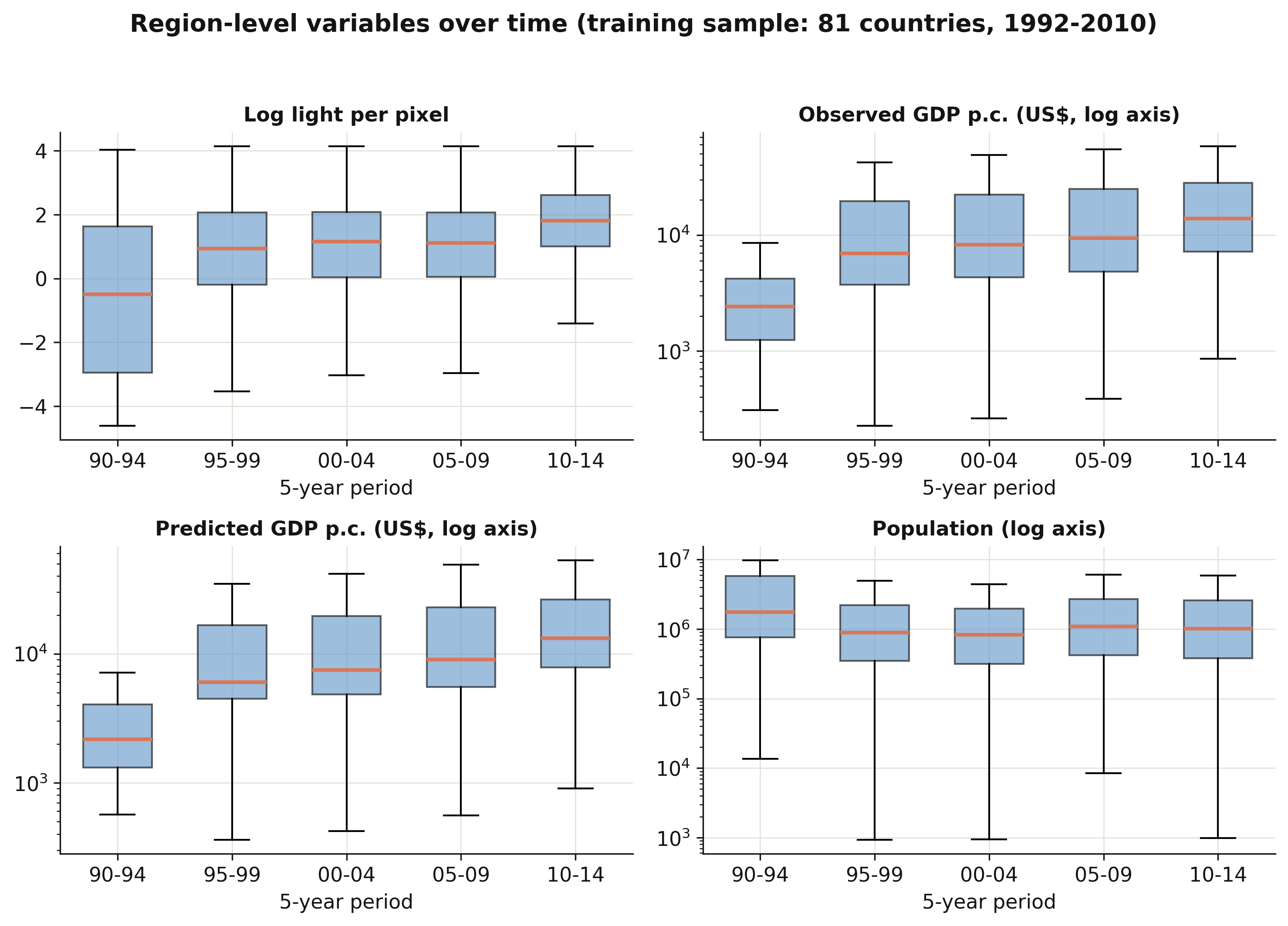
The region-level panels (from Prediction_Data and Table_2, the 81-country training sample) tell a
clear growth story: log light per pixel and both observed and predicted GDP per capita shift
upward period by period — median region income rises more than fivefold, from about \$2,400 in
1990–94 to \$13,800 in 2010–14 — while regional population is broadly flat with an enormous spread
(regions span five orders of magnitude). The light and income boxes also widen over time, a reminder
that the DMSP sensors read brighter in later years.
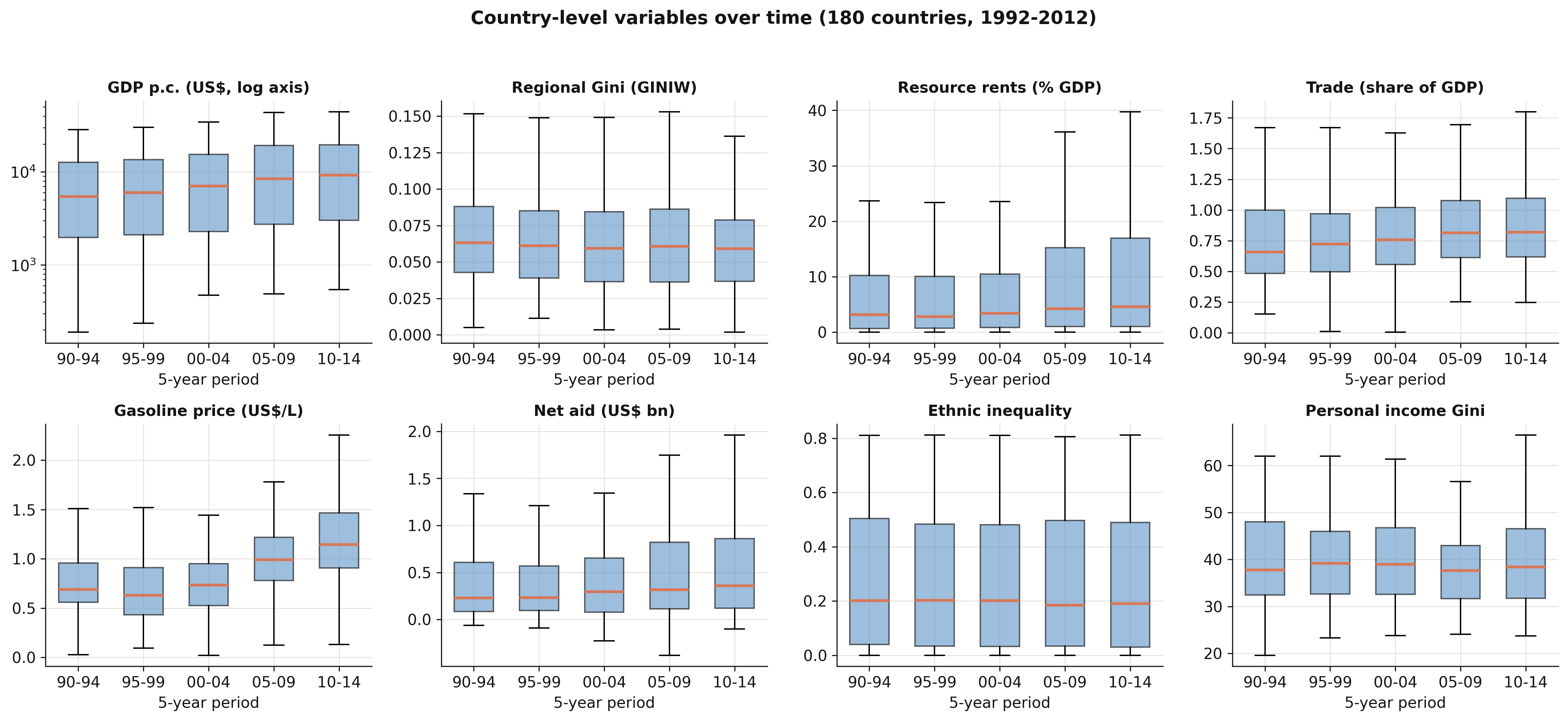
The country-level panels pull from three datasets — Table_3 (GDP and the regional Gini), Table_4
(the determinants), and Figure_5 (the personal Gini). Country GDP per capita rises steadily; the
regional Gini is strikingly stable around 0.06 with a slowly narrowing spread (the convergence §5
will quantify); gasoline prices and trade shares drift upward; resource rents and net
aid are heavily right-skewed with fat upper tails in every period; and the personal income Gini
edges down. Two cautions the boxes make obvious: the determinants are noisier and patchier than the
core variables (recall their thinner coverage, §4.4), and the region-level boxes describe only the
81-country training subsample, not all 180 countries.
With the data documented, we look at how inequality behaves across countries.
5. Cross-country dynamics of inequality
Before predicting or regressing anything, it pays to see the data. This section maps the landscape: how the key variables are distributed, how regional inequality has moved over two decades, how it differs across world regions, and how the five inequality indices relate to one another. Every chart here is descriptive — it raises the questions the later models try to answer.
5.1 Distributions of the key variables
We begin with three histograms: the log of nighttime light per pixel and the log of regional GDP per capita (both at the region level), and the population-weighted regional Gini (at the country level). Looking at distributions first tells us whether variables are skewed, bounded, or multi-modal — facts that shape the models we can fit.
# three histograms side by side; .dropna() drops missing values before plotting
fig, axes = plt.subplots(1, 3, figsize=(12, 3.6))
axes[0].hist(pred["log_Light_ppix_Region"].dropna(), bins=40, color=STEEL)   # log light
axes[1].hist(np.log(pred["GDP_pc_Region"].dropna()), bins=40, color=ORANGE)  # log region income
axes[2].hist(t3["GINIW_pred_GDP_pc"].dropna(), bins=40, color=TEAL)          # regional Gini
# ... titles and labels omitted for brevity (see script.py)
fig.savefig("python_kuznets_dmsp_01_distributions.png", dpi=300)

print("GINIW: mean={:.3f}, median={:.3f}, max={:.3f}".format(
    t3["GINIW_pred_GDP_pc"].mean(), t3["GINIW_pred_GDP_pc"].median(),
    t3["GINIW_pred_GDP_pc"].max()))
GINIW: mean=0.064, median=0.061, max=0.163
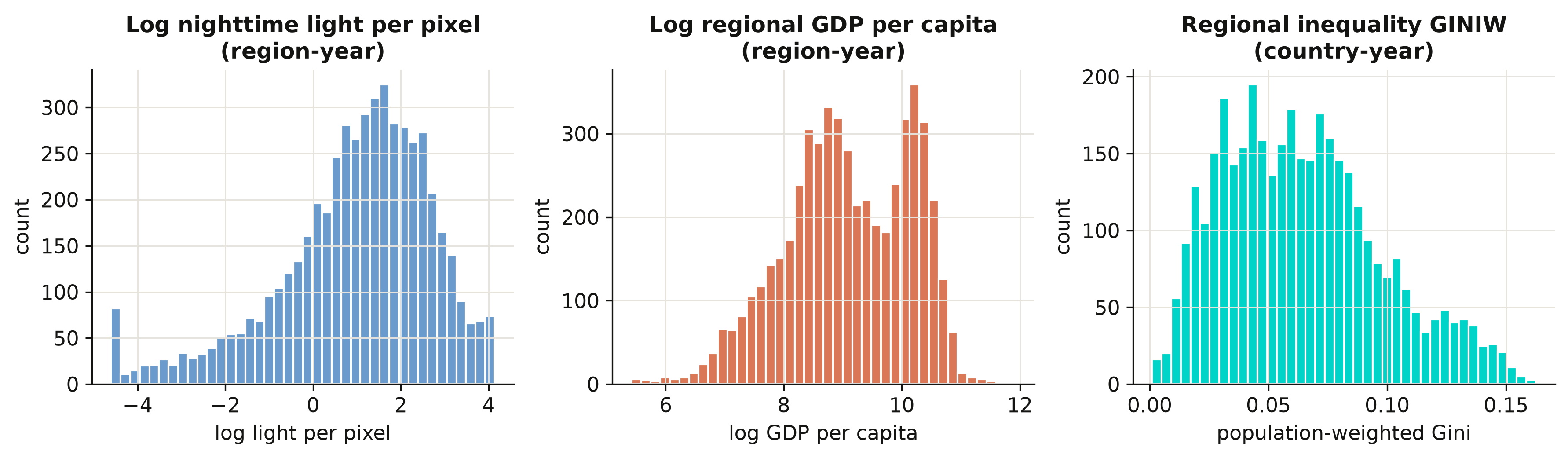
Log light and log income are both roughly bell-shaped — taking logs tames their heavy right skew, which is why the calibration model in Section 6 works in logs. The regional Gini is right-skewed and bounded below by zero, with a mean of 0.064 and a maximum of 0.163: most countries are internally fairly equal, but a long tail of countries has very uneven regions. That tail is what the rest of the post is about.
5.2 Inequality and income over time
Has regional inequality risen or fallen as the world grew richer? We average the regional Gini and log GDP per capita across all countries in each year from 1992 to 2012 and plot them on a shared timeline. Plotting the two series together previews the Kuznets question: do they move in the same direction or in opposite directions?
# Read this pandas chain top to bottom:
yr = (t3[(t3.year >= 1992) & (t3.year <= 2012)]           # 1. keep years 1992-2012
      .assign(logGDP=lambda d: np.log(d.GDP_pc_Country))  # 2. add a log-income column
      .groupby("year")                                    # 3. one group per year
      .agg(GINIW=("GINIW_pred_GDP_pc", "mean"),           # 4. average the Gini each year ...
           logGDP=("logGDP", "mean"))                     #    ... and the log income too
      .reset_index())
print(yr.iloc[[0, -1]].round(4).to_string(index=False))   # show the first & last year
 year   GINIW  logGDP
 1992  0.0702  8.5969
 2012  0.0612  8.9956
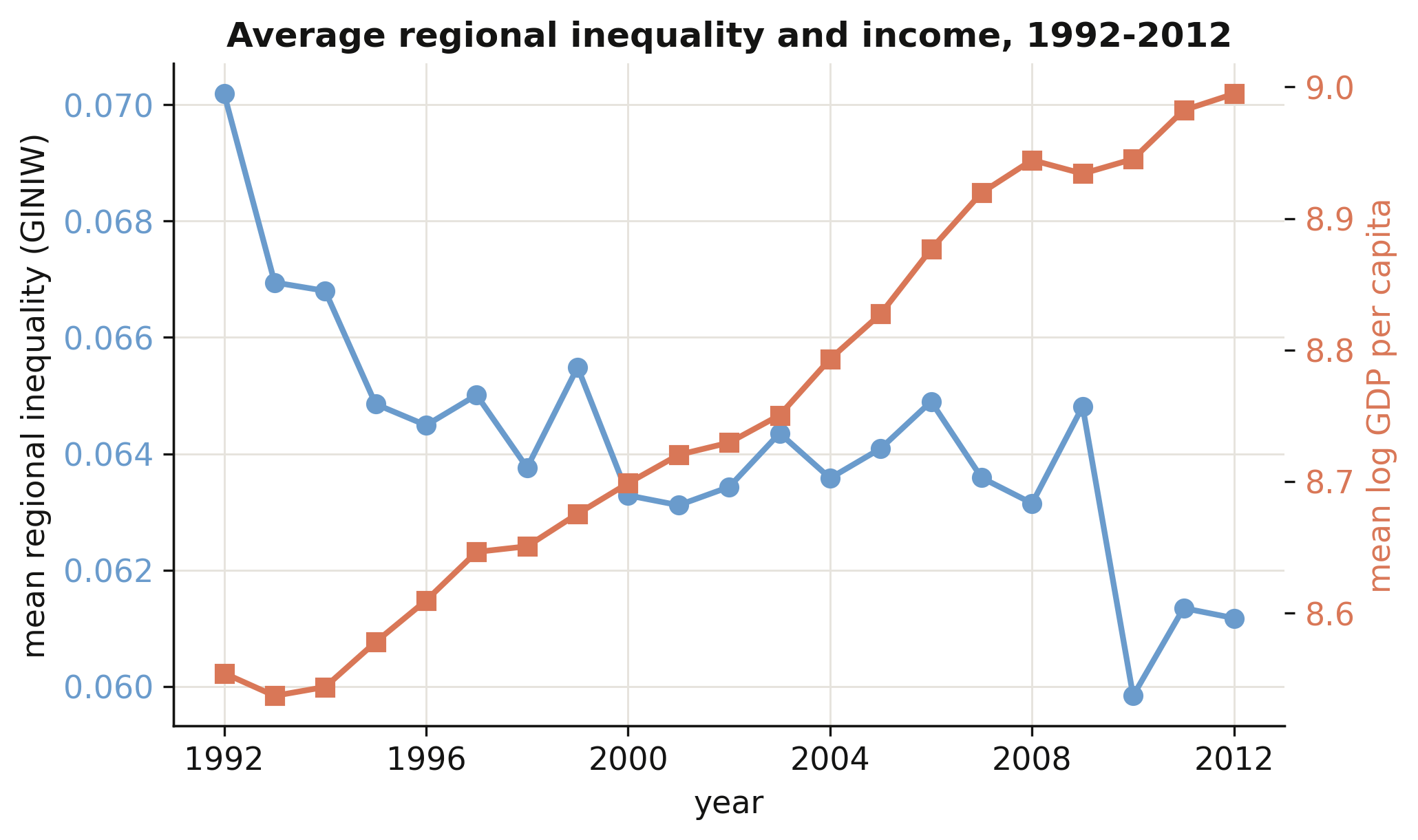
As average world income climbed (orange, rising), average regional inequality fell from 0.070 in 1992 to 0.061 in 2012 (steel, declining). Globally, then, growth and falling within-country inequality went together over this period — a first hint that, on the downward arm of the Kuznets curve, development narrows regional gaps. But an average hides enormous variation across regions of the world, which we look at next.
5.3 Inequality across world regions
We group countries into the World Bank’s regions and draw a box plot of the regional Gini for each. A box plot shows the median (the orange line), the middle half of countries (the box), and the spread (the whiskers), so we can compare both typical levels and dispersion across world regions at a glance.
country_group = (pred.assign(g=pred.filter(["eap","eca","lac","mena","sa","ssa"])
                 .idxmax(axis=1)))   # each region's World Bank group
eda = t3.copy()
eda["wb_group"] = eda["Country_ISO"].map(country_group_lookup)  # see script.py
print(eda.groupby("wb_group")["GINIW_pred_GDP_pc"].median().sort_values().round(4))
N. America & high-inc.     0.0385
Europe & Central Asia      0.0421
South Asia                 0.0451
Mid. East & N. Africa      0.0585
Latin America & Carib.     0.0724
East Asia & Pacific        0.0780
Sub-Saharan Africa         0.0962
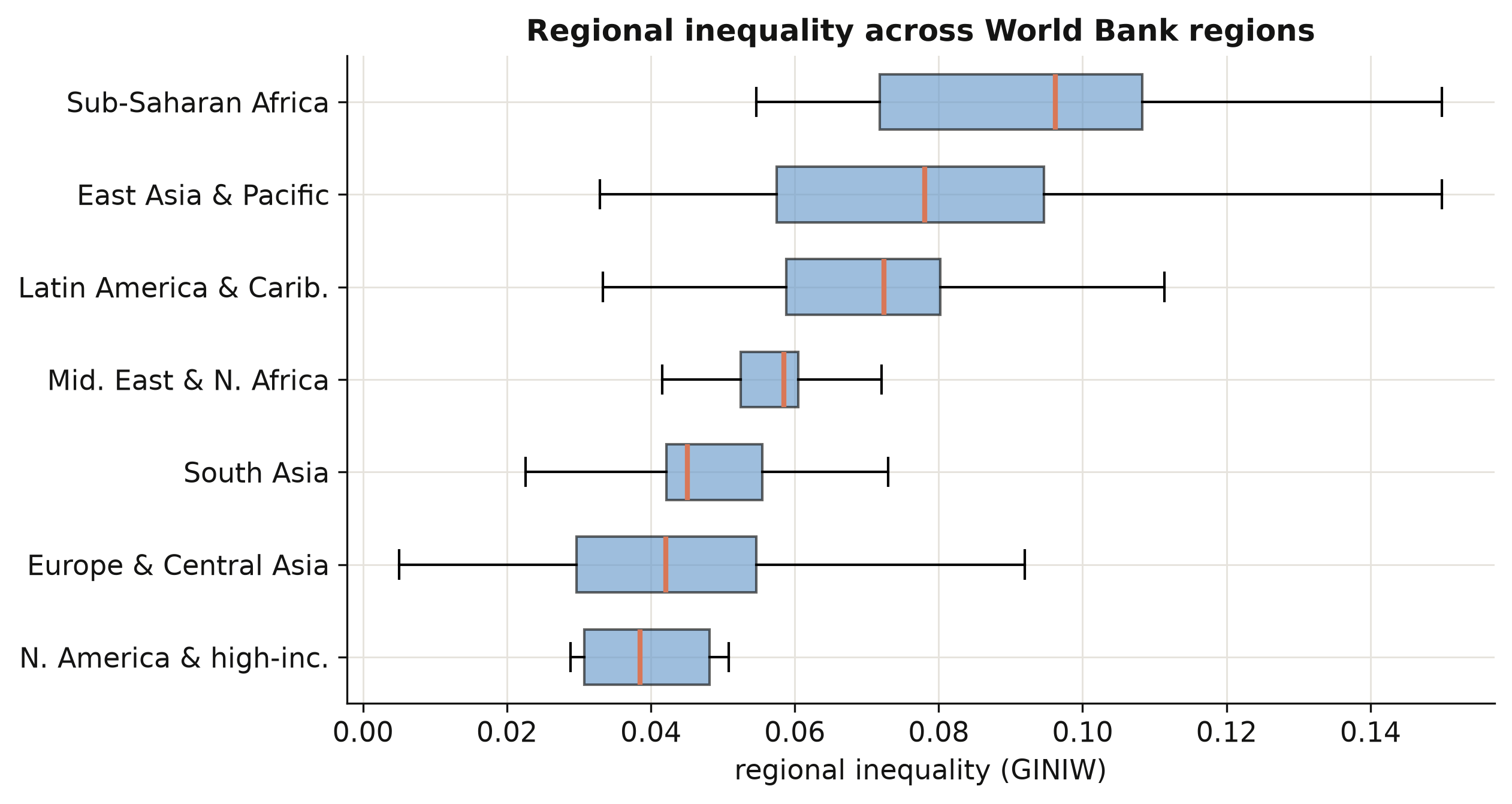
The ordering is striking. Sub-Saharan Africa has the highest median regional inequality (0.096) — two and a half times that of North America and high-income countries (0.039) — with East Asia and Latin America close behind. Rich regions are not only richer on average; their internal income map is far more even. This cross-section already sketches the downward arm of a Kuznets relationship, which Section 8 will estimate properly.
5.4 How the five indices co-move
The paper measures inequality five ways: the Gini, the coefficient of variation (CV), and three generalized-entropy indices — GE(−1), GE(0) (the mean log deviation), and GE(1) (the Theil index). Do they tell the same story? We compute their correlation matrix across all country-years. If the indices co-move tightly, our headline Gini results will not hinge on that particular choice.
IDX = ["GINIW_pred_GDP_pc", "COVW_pred_GDP_pc", "GE_1W_pred_GDP_pc",
       "GE_0W_pred_GDP_pc", "GE_m1W_pred_GDP_pc"]
cmat = t3[IDX].corr()
print("corr(Gini, CV)   = %.3f" % cmat.iloc[0, 1])
print("corr(Gini, Theil)= %.3f" % cmat.iloc[0, 2])
corr(Gini, CV)   = 0.969
corr(Gini, Theil)= 0.927
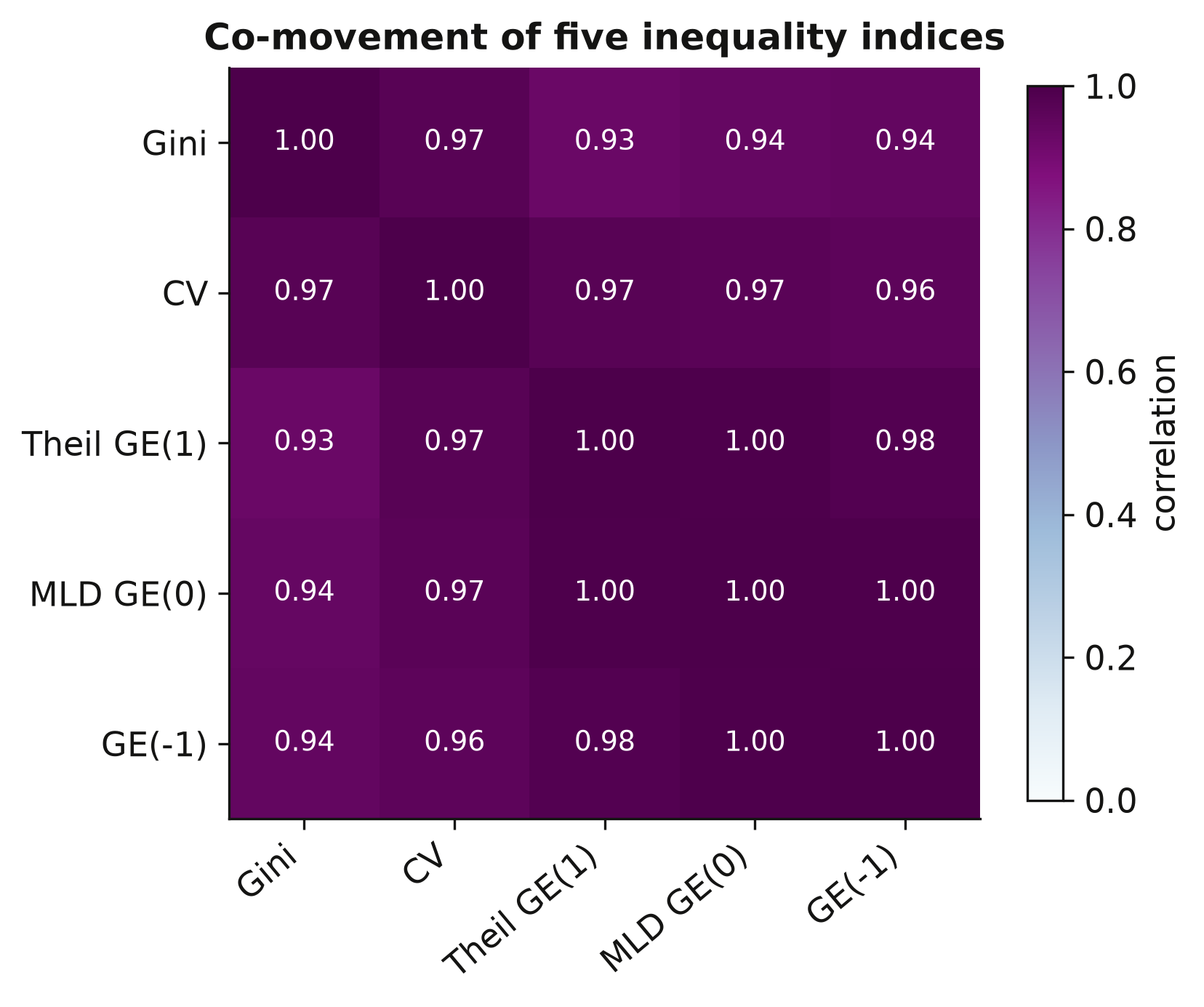
All five indices correlate above 0.9 — the Gini and the CV move almost in lockstep (0.97). This is reassuring: whichever index we lead with, the qualitative findings will be the same, so the Gini’s prominence below is a matter of convention, not of cherry-picking. With the landscape mapped, we turn to the engine of the whole exercise — turning light into income.
6. Predicting GDP from nighttime lights
This is the first of the two construction stages, and the foundation of everything that follows. The goal is a prediction model: feed it a region’s nighttime brightness plus a handful of controls, and it returns a guess of that region’s income. Once the model is trained on the regions where we do observe income, we can turn it loose on the tens of thousands of regions where we do not — which is the whole reason the satellite data is so valuable. We build the model exactly as Table 1 of the paper does, calibrating it on the 1,504 regions that have observed income.
Why should light predict income at all? At night, economic activity — factories, offices, lit streets, houses with electricity — shows up from space as brightness, and richer places tend to be brighter. The relationship is far from perfect (an oil field flares brightly with almost no one around; a dense but poor city can be dim), which is exactly why we add controls and, later, measure how good the predictions really are.
6.1 The idea: light as a proxy for income
We regress the log of a region’s GDP per capita on the log of its light per pixel, plus controls that soak up everything brightness should not be given credit for — the country’s overall income level, geography, the satellite generation, and the broad world region. Working in logs lets us read the slope as an elasticity: a percentage change in light maps to a percentage change in income. Formally:
$$y_r = \beta_0 + \beta_1 \ell_r + \beta_2 g_c + \gamma’ X_r + \mu_g + \tau_s + \varepsilon_r$$
Reading the equation one term at a time, with the dataset column name in parentheses:
- $y_r$ — log regional GDP per capita (
log_GDP_pc_Region): the outcome we want to predict, for region $r$. - $\beta_1 \ell_r$ — the light elasticity $\beta_1$ times log light per pixel
(
log_Light_ppix_Region). This is the one coefficient we truly care about: how strongly brightness tracks income once everything else is held fixed. - $\beta_2 g_c$ — an adjustment for log national GDP per capita (
log_GDP_pc_Country) of region $r$’s country $c$. Without it, light would be unfairly credited with gaps that are really just rich-country-versus-poor-country differences. - $\gamma’ X_r$ — the geography controls (
log_area, the number of regionslog_region, their interactionlog_region_X_log_area, and two pixel-saturation countslog_N_pix_top_cod_1_ppix/log_N_pix_low_cod_1_ppix). These absorb the fact that a physically huge region, or one whose brightest pixels are “topped out” at the sensor’s maximum, registers light differently for reasons that have nothing to do with being rich. - $\mu_g$ — a world-region fixed effect (
group_id, e.g. Sub-Saharan Africa, Latin America): a separate baseline for each broad region, soaking up whatever makes a whole continent systematically brighter or dimmer. - $\tau_s$ — a satellite-generation fixed effect (
satyear): different satellites and years calibrate brightness differently, and this term absorbs those technical differences. - $\varepsilon_r$ — everything left over.
Each control answers a specific “but couldn’t that gap just be …?” objection. Drop the national-income term and $\beta_1$ would partly pick up between-country wealth gaps; drop the satellite effect and it would partly pick up sensor changes. What survives on $\beta_1$ is the part of the brightness–income link we can actually defend.
A quick feel for the magnitude: an elasticity of, say, $0.10$ means a region that is twice as bright (a 100% increase in light) is predicted to be only about 7% richer, since $2^{0.10}\approx 1.07$. Light moves far more than income — brightness is a noisy proxy, useful on average but nowhere near one-for-one.
6.2 Building the model up, one control at a time
The paper does not jump straight to the full model. It builds up in seven steps, each adding a
fixed effect or a control, so we can watch the light elasticity change as more is held
fixed. That progression is itself the lesson: it reveals how much of the raw brightness–income
link is real, and how much was just rich-versus-poor confounding. We estimate each step with
PyFixest (pf.feols), which fits ordinary least squares with optional fixed effects.
Two pieces of PyFixest syntax for newcomers. Anything after the | in the formula is a
fixed effect — a separate intercept for every value of that column, swept out of the data
before the slope is estimated. And vcov={"CRV1": "Country_ISO"} asks for standard errors
clustered by country: it tells the model that regions in the same country are not
independent observations, so it should not over-state how precise the estimates are.
First we build the two label columns the fixed effects need:
# --- Step 1: build the categorical columns the fixed effects need ----------
# PyFixest wants ONE label column per fixed effect (not a wall of 0/1 dummies).

# satyear_1 ... satyear_7 are 0/1 flags; fold them into a single 1-7 code.
pred["satyear"] = sum(i * pred[f"satyear_{i}"] for i in range(1, 8)).astype(int)

# eap/eca/.../ssa are 0/1 world-region flags. idxmax(axis=1) returns, for each
# row, the NAME of the column that equals 1 -- i.e. it turns the one-hot dummies
# back into a single world-region label per region.
pred["group_id"] = pred.filter(["eap", "eca", "lac", "mena", "sa", "ssa"]).idxmax(axis=1)
Now the ladder. We show four specifications — pooled, region fixed effects, plus national income, and the full model — and print the light elasticity at each:
# --- Step 2: the ladder of specifications (each spec adds something) --------
GEO = ("log_N_pix_top_cod_1_ppix + log_N_pix_low_cod_1_ppix + log_area + "
       "log_region + log_region_X_log_area")                # the geography controls
specs = {
  # spec 1: pooled OLS, no fixed effects -- the raw, confounded correlation
  1: "log_GDP_pc_Region ~ log_Light_ppix_Region",
  # spec 2: + region & satellite FE -> the clean WITHIN-region elasticity
  2: "log_GDP_pc_Region ~ log_Light_ppix_Region | code_Coutry_Region + satyear",
  # spec 4: + national income, so light is not credited with rich-vs-poor gaps
  4: "log_GDP_pc_Region ~ log_Light_ppix_Region + log_GDP_pc_Country | Country_ISO + satyear",
  # spec 7: + all geography controls and world-region FE -- the full model
  7: f"log_GDP_pc_Region ~ log_Light_ppix_Region + log_GDP_pc_Country + {GEO} | group_id + satyear",
}

# --- Step 3: fit each spec and read off the light elasticity ----------------
for k, fml in specs.items():
    m = pf.feols(fml, data=pred, vcov={"CRV1": "Country_ISO"})   # cluster by country
    print(f"col {k}: light elasticity = {m.coef()['log_Light_ppix_Region']:.3f}")
col 1: light elasticity = 0.359
col 2: light elasticity = 0.190
col 4: light elasticity = 0.131
col 7: light elasticity = 0.049
Watch the elasticity fall as we climb the ladder. The pooled estimate of 0.359 (column 1) blends two very different comparisons: brighter-versus-dimmer regions within a country, and richer-versus-poorer countries. Adding region fixed effects (column 2) discards the cross-region comparison and keeps only the within-region one — the elasticity drops to 0.190. This is the clean within-region number, and it is the one Section 11 later stress-tests for spatial correlation. Adding national income (column 4, 0.131) strips out what was really a country-level wealth effect, and the full model with every geography control (column 7, 0.049) leaves only the thin sliver of variation that survives after region, country, and continent are all accounted for.
So which number is “right”? It depends on what we plan to do with the model — and that turns on the choice between fixed effects and random effects. That choice is important enough, and is the estimator the paper actually publishes, that it gets its own section.
6.3 Fixed effects vs random effects — and why prediction needs random effects
This is the conceptual core of the whole construction, so we will take it slowly. Both estimators fit the same equation; they differ in what variation they use and — crucially for us — in whether the fitted model can be applied to a brand-new region.
Fixed effects (FE) give every region its own intercept and then compare a region only to itself over time. Every difference between regions is swept away as a nuisance. This is wonderfully safe: anything permanent about a region — its terrain, its history, its institutions — is automatically controlled for, even things we never measured. But there is a price. The region intercepts are estimated only for regions in the training sample. Show a fitted FE model a region it has never seen, and it has no intercept for that region; it literally cannot produce a prediction.
Random effects (RE) instead treat each region’s intercept as a random draw from a common distribution with one estimated mean and variance. Because the region effect is now summarised by a couple of shared parameters rather than one free intercept per region, the model can use both the within-region variation (changes over time) and the between-region variation (richer-versus-poorer regions). The payoff is decisive: RE produces one coefficient vector that applies to any region, in the sample or out of it — so we can predict income for the tens of thousands of regions that have no income statistics at all.
| Fixed effects | Random effects (used by the paper) | |
|---|---|---|
| Uses which variation? | within-region only | within and between region |
| Controls unobserved region traits? | yes, automatically | only if uncorrelated with the regressors |
| Predict for a new, unseen region? | no (no intercept for it) | yes — one shared model |
| Use of the data | discards between-region signal | more efficient |
| Key assumption | none on the region effect | region effect uncorrelated with regressors |
For the paper’s goal — drawing a global income map by predicting every region on Earth —
fixed effects are simply not an option, and that is exactly why the published Table 1 uses
random effects. PyFixest does only FE/OLS, so for this one step we switch to
linearmodels.RandomEffects. Let us build the random-effects fit slowly, in four steps.
# --- Step 1: tell the estimator the panel structure ------------------------
# A "panel" = the same units (regions) observed over several years. Indexing by
# (region, year) tells RandomEffects which rows belong to the same region.
panel = pred.set_index(["code_Coutry_Region", "year"])
# --- Step 2: cluster the standard errors by country ------------------------
# Regions in the same country move together, so we cluster on country: turn each
# country code into an integer label (one per row) for the clustered covariance.
clusters = pd.DataFrame(
    {"c": pd.Categorical(panel["Country_ISO"]).codes},
    index=panel.index,
)
# --- Step 3: a small helper that fits the RE model for any set of regressors --
def re_fit(cols):
    # Always prepend a constant -- the shared baseline intercept ...
    X = pd.concat([pd.Series(1.0, index=panel.index, name="const")] + cols, axis=1)
    y = panel["log_GDP_pc_Region"]                  # outcome: log regional income
    # ... then fit random effects with country-clustered standard errors.
    return RandomEffects(y, X).fit(cov_type="clustered", clusters=clusters)
# --- Step 4: fit the full (column-7) specification -------------------------
# Regressors: log light + log national income + the five geography controls,
# the world-region dummies, and the satellite-generation dummies.
re7 = re_fit([
    panel[["log_Light_ppix_Region", "log_GDP_pc_Country",
           "log_N_pix_top_cod_1_ppix", "log_N_pix_low_cod_1_ppix",
           "log_area", "log_region", "log_region_X_log_area"]],
    pd.get_dummies(panel["group_id"], drop_first=True).astype(float),  # world region
    panel[[f"satyear_{i}" for i in range(1, 8)]].astype(float),        # satellite
])
print("RE col 7 light elasticity        = %.3f" % re7.params["log_Light_ppix_Region"])
print("RE col 7 national-GDP elasticity  = %.3f" % re7.params["log_GDP_pc_Country"])
RE col 7 light elasticity        = 0.102
RE col 7 national-GDP elasticity  = 0.889
The random-effects light elasticity in column 7 is 0.102 — exactly the paper’s published number — versus the 0.049 we got from fixed effects. Why is RE roughly twice as large? Because it keeps the between-region information that the within estimator threw away: with national income already absorbing most of the scale, the between-region spread is precisely where light still earns its keep. The national-income elasticity of 0.889 confirms that a region’s income tracks its country’s income almost one-for-one, with light supplying the remaining subnational detail.
We report all seven specifications side by side below. The note records that the random-effects elasticity is essentially identical to the FE/OLS estimate; column 2, the one pure fixed-effects column, is where FE and RE coincide at 0.190.
# --- the seven specifications side by side, as in the paper's Table 1 ------
import maketables as mt
et1 = mt.ETable(
    [fe_models[k] for k in range(1, 8)],
    head_order="d",                                # header: dependent variable + (1)-(7)
    labels={"log_GDP_pc_Region": "log regional GDP per capita", ...},  # readable names
    coef_fmt="b:.3f* (se:.3f)", show_fe=True,
)
et1.make("html")                                   # -> self-contained HTML table
| Table 1. Nighttime lights predict regional GDP per capita | |||||||
| log regional GDP per capita | |||||||
|---|---|---|---|---|---|---|---|
| (1) | (2) | (3) | (4) | (5) | (6) | (7) | |
| coef | |||||||
| log light per pixel | 0.359*** (0.041) | 0.190*** (0.041) | 0.134*** (0.035) | 0.131*** (0.035) | 0.268*** (0.038) | 0.094*** (0.021) | 0.049* (0.026) |
| log GDP p.c. (country) | 0.864*** (0.039) | 0.945*** (0.036) | 0.896*** (0.034) | ||||
| log # top-coded pixels | 0.027*** (0.007) | ||||||
| log # low-coded pixels | -0.018** (0.007) | ||||||
| log area | 0.174*** (0.041) | ||||||
| log # regions | 0.463*** (0.122) | ||||||
| log # regions × log area | -0.043*** (0.010) | ||||||
| Intercept | 8.754*** (0.105) | ||||||
| fe | |||||||
| Country FE | - | - | x | x | - | - | - |
| Region FE | - | x | - | - | - | - | - |
| WB-group FE | - | - | - | - | x | x | x |
| Satellite FE | - | x | x | x | x | x | x |
| stats | |||||||
| Observations | 5,258 | 5,216 | 5,258 | 5,258 | 5,258 | 5,258 | 5,258 |
| R2 | 0.361 | 0.979 | 0.857 | 0.866 | 0.578 | 0.844 | 0.86 |
| Dependent variable: log regional GDP per capita (PyFixest FE/OLS; SEs clustered by country, in parentheses). The coefficient on log light per pixel is the elasticity. The random-effects estimator used in the published table is very close (col 7: RE=0.102). * p<.1 ** p<.05 *** p<.01. | |||||||
6.4 Forming the predictions — and a worked example
A model is only useful if we can actually predict with it. Prediction here is mechanical: take each region’s characteristics, multiply them by the estimated random-effects coefficients, and add everything up. That gives a fitted log income; because the model is in logs, we exponentiate to get back to dollars.
# --- Step 1: predicted LOG income = (design matrix) x (RE coefficients) -----
# X7 has one row per region-year and one column per regressor (plus the constant).
# The matrix product X7 @ beta applies the SAME coefficient vector to every region --
# this is what fixed effects could not do, and why we used random effects.
X7         = re_design([...])                                   # design matrix (see script.py)
fitted_log = X7.values @ re7.params.reindex(X7.columns).values  # X . beta

# --- Step 2: undo the log to get dollars, then check against reality --------
pred_pc = np.exp(fitted_log)                # predicted GDP per capita, in dollars
obs_log = panel["log_GDP_pc_Region"].values
r = np.corrcoef(fitted_log, obs_log)[0, 1]  # how close are predictions to observed income?
print(f"corr(predicted, observed log GDP per capita) = {r:.3f}")
corr(predicted, observed log GDP per capita) = 0.925
A worked example, by hand. Imagine a region with log light per pixel
$\ell_r = 1.5$ in a country with log national income $g_c = 9.0$, and suppose (to keep it
simple) its geography controls and region/satellite effects net out to roughly zero. Using the
two headline coefficients, its predicted log income is about the shared constant, plus
$0.102 \times 1.5$ from light, plus $0.889 \times 9.0$ from national income. Notice how the
national-income term dominates: most of a region’s predicted income comes from which
country it is in, while light nudges the estimate up or down to capture how that particular
region compares with its neighbours. Exponentiating the sum returns a figure in dollars. The
full model simply does this for all 5,258 region-years at once with the matrix product
X7 @ beta.
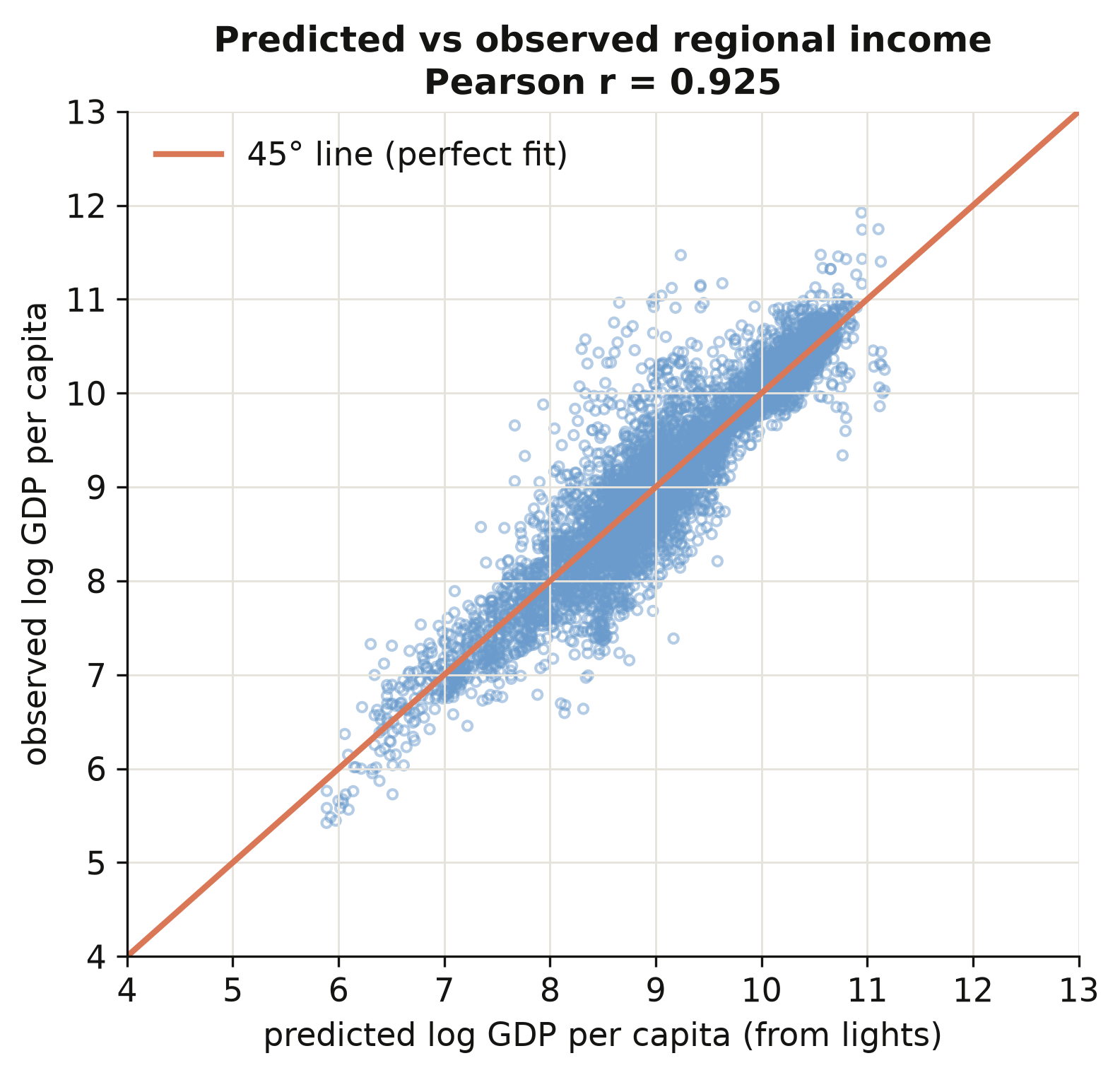
Predicted and observed log income correlate 0.925 across all 5,258 region-years, and the scatter hugs the 45° line across four orders of magnitude of income (figure above). The model is not just memorising one income band — it generalises from the poorest regions to the richest. That is what licenses the paper’s key move: applying these random-effects coefficients to every region on Earth, including the tens of thousands with no income statistics, to build a complete global income map. With predicted income in hand, we can finally measure inequality.
7. Constructing the inequality indicators
This is the second construction stage. We now have a predicted income for every region; the task is to compress each country’s many regional incomes into a single number that says how unequal they are — and to do it in a way that respects population. We build the indices from scratch so that nothing is a black box.
7.1 From many regional incomes to one number
Every index starts from the same three ingredients. Let region $i$ have income $y_i$ and population $w_i$. The population-weighted mean, the population shares, and the relative incomes are
$$\bar y = \frac{\sum_i w_i y_i}{\sum_i w_i}, \qquad p_i = \frac{w_i}{\sum_j w_j}, \qquad r_i = \frac{y_i}{\bar y}.$$
In words, $\bar y$ is the average income a randomly chosen person (not region) lives in,
$p_i$ is the share of the country’s people in region $i$, and $r_i$ is region $i$’s income
relative to the national average. In code, $y_i$ is pred_GDP_pc_Region, $w_i$ is
Pop_Region, and the indices below are all built from p and r. Weighting by population
is the key design choice: a region matters in proportion to how many people experience its
income.
A tiny example makes this concrete. Suppose a country has three regions with incomes $y = (1, 2, 3)$ and equal populations $w = (1, 1, 1)$. Then the population-weighted mean is $\bar y = (1+2+3)/3 = 2$, each population share is $p_i = 1/3$, and the relative incomes are $r = (0.5, 1.0, 1.5)$ — the poor region earns half the average, the rich one earns 1.5×. Every index below is just a different way of summarising how far that vector $r$ spreads away from $1$. If the three populations were unequal — say the rich region held most of the people — the same incomes would produce a different mean and different shares, and the inequality numbers would move accordingly. That is population weighting at work.
7.2 The five indices from scratch
The Gini is the average absolute income gap between two randomly chosen people, scaled to lie in $[0, 1]$. The generalized-entropy family $GE(\alpha)$ varies in how sharply it reacts to gaps at the top ($\alpha$ large) or bottom ($\alpha$ small) of the distribution, and the coefficient of variation is the standard deviation over the mean. We implement all five directly:
$$G = \frac{\sum_i \sum_j w_i w_j , |y_i - y_j|}{2 \left(\sum_i w_i\right)^2 \bar y}, \qquad GE(0) = \sum_i p_i \ln!\frac{1}{r_i}, \qquad GE(1) = \sum_i p_i , r_i \ln r_i.$$
In words, the Gini $G$ sums the population-weighted absolute gaps $|y_i - y_j|$ between every pair of regions and normalises by twice the squared population and the mean; $GE(0)$ (the mean log deviation) and $GE(1)$ (the Theil index) are population-weighted averages of log relative income. A crucial coding detail: the Gini uses the absolute difference $|y_i - y_j|$, summed over all pairs — not a product — which is the classic trap when writing a weighted Gini by hand.
We build all five indices in a single function, ineq_indices(y, w), where y is the vector
of regional incomes and w the vector of regional populations. Let us read it in three steps.
First, clean the inputs and form the three ingredients from §7.1:
def ineq_indices(y, w):
    """Five population-weighted inequality indices from first principles."""
    # --- Step 1: clean the inputs ------------------------------------------
    y, w = np.asarray(y, float), np.asarray(w, float)
    ok = np.isfinite(y) & np.isfinite(w) & (w > 0) & (y > 0)   # drop missing / non-positive
    y, w = y[ok], w[ok]

    # --- Step 2: the three ingredients (mean, shares, relative incomes) -----
    sw = w.sum()                       # total population
    mu = (w * y).sum() / sw            # population-weighted mean income (ȳ)
    p  = w / sw                        # population shares (pᵢ, they sum to 1)
    r  = y / mu                        # relative incomes (rᵢ = yᵢ / ȳ)
Next, the four entropy-style indices. Each is a weighted average over p of some function of
r; they differ only in which function, which is what makes each one sensitive to a
different part of the distribution:
    # --- Step 3a: the generalized-entropy family + coefficient of variation -
    ge_m1 = 0.5 * ((p * r**-1).sum() - 1)      # GE(-1): very sensitive to the poorest
    ge_0  = (p * (-np.log(r))).sum()           # GE(0)  = mean log deviation
    ge_1  = (p * r * np.log(r)).sum()          # GE(1)  = Theil index
    cv    = np.sqrt(2 * 0.5 * ((p * r**2).sum() - 1))   # coefficient of variation
Finally, the Gini. This is the one line worth slowing down on:
    # --- Step 3b: the Gini = population-weighted average gap between people --
    # y[:, None] - y[None, :] builds the full matrix of pairwise income gaps:
    # entry (i, j) is yᵢ - yⱼ. np.abs makes them |yᵢ - yⱼ|; np.outer(w, w)
    # weights each pair by both populations. Summing and normalising gives Gini.
    gini = (np.abs(y[:, None] - y[None, :]) * np.outer(w, w)).sum() / (2 * sw**2 * mu)
    return dict(GINIW=gini, GE_m1W=ge_m1, GE_0W=ge_0, GE_1W=ge_1, COVW=cv)
Two things to flag for beginners. The expression y[:, None] - y[None, :] is a NumPy
broadcasting trick: it turns a length-$n$ vector into an $n\times n$ matrix of all pairwise
differences in one stroke, with no Python loop. And the classic trap when coding a weighted
Gini by hand is to forget the absolute value — the Gini sums $|y_i - y_j|$, the size of
each gap, not the signed difference or a product; drop the np.abs and the answer collapses to
zero.
This single function is the whole measurement apparatus. It takes a country-year’s regional incomes and populations and returns all five indices. Everything downstream — the Kuznets curve, the determinants — is just these numbers, regressed. To trust them, we test the function on a country we can reason about.
7.3 A worked example: Germany
Germany is a good test case: 16 regions of broadly similar income, so we expect a low inequality number. We pull its 2010 regions and run them through the function by hand.
# Pull Germany's 2010 rows, then feed its regional incomes + populations
# straight into the function we just wrote and print all five indices.
deu = t2[(t2.Country_ISO == "DEU") & (t2.year == 2010)]
print("regions:", len(deu))
print(ineq_indices(deu["pred_GDP_pc_Region"], deu["Pop_Region"]))
regions: 16
{'GINIW': 0.0278, 'GE_m1W': 0.0017, 'GE_0W': 0.0016,
 'GE_1W': 0.0016, 'COVW': 0.0565}
Germany’s 16 regions yield a population-weighted Gini of 0.028 — very low, as expected for a country whose regions cluster near the national average. The Theil index (0.0016) and the others agree on the same verdict. A concrete, hand-checkable number like this is the sanity check that the formula is implemented correctly before we apply it to 180 countries.
7.4 The role of population weights
Does population weighting actually change anything? We recompute the Gini for every country-year without weights — letting every region count once — and compare. This isolates exactly what the weights do.
# --- Step 1: an equal-weight Gini (same formula, but every region counts once) --
# Note what is missing versus ineq_indices: no population weights w, no np.outer.
def gini_unweighted(y):
    y = np.asarray(y, float); y = y[np.isfinite(y) & (y > 0)]
    n, mu = y.size, y.mean()
    return np.abs(y[:, None] - y[None, :]).sum() / (2 * n**2 * mu)

# --- Step 2: compare the two Ginis across every country-year -------------------
# `built` already holds the weighted GINIW and the equal-weight GINI_unw side by side.
corr_wu  = built["GINIW"].corr(built["GINI_unw"])          # do they even agree?
mean_gap = (built["GINIW"] - built["GINI_unw"]).mean()     # and in which direction?
print(f"corr(weighted, unweighted) = {corr_wu:.3f}")
print(f"mean(weighted - unweighted) = {mean_gap:+.4f}")
corr(weighted, unweighted) = 0.747
mean(weighted - unweighted) = -0.0034
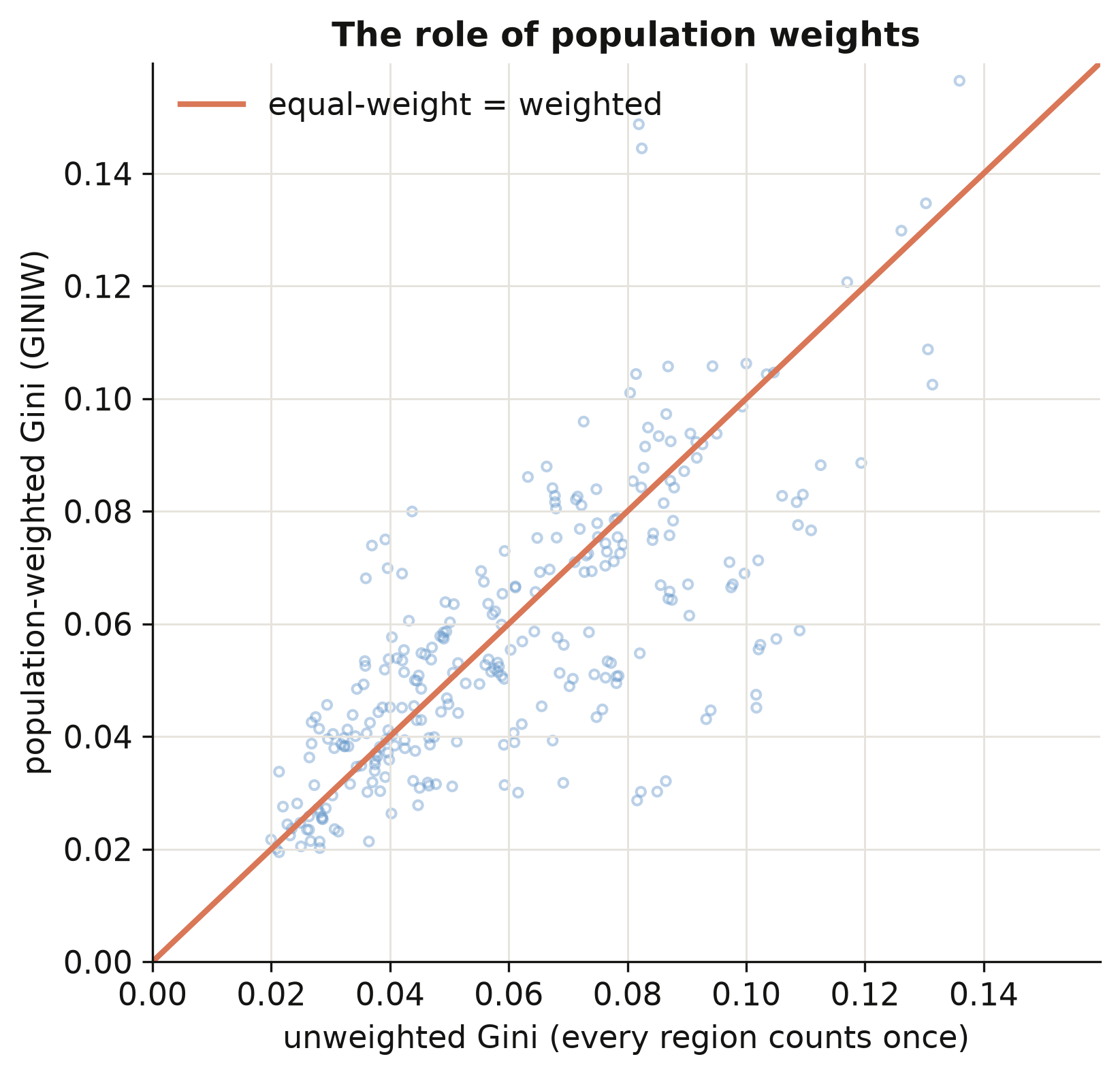
The weighted and unweighted Gini correlate only 0.75 — far from identical — and weighting lowers inequality on average by 0.0034. The scatter (figure above) shows most points below the 45° line: population weighting pulls the index down because small, income-extreme regions (a tiny mining province, a remote capital) count for less when we weight by people. The lesson is general — report your weighting: the same country can look more or less unequal depending on whether you count regions or people, and “by people” is usually the policy-relevant choice.
7.5 Do our indices match the paper?
Two checks. First, the from-scratch indices should reproduce the paper’s Table 2 — the correlation between inequality measured from predicted income and inequality measured from observed income. Second, an honest caveat about coverage.
import maketables as mt
# For each index we have two correlations across countries (2001-2012 means):
#   pred_obs  = inequality from PREDICTED income vs from OBSERVED income (our method)
#   light_obs = inequality from RAW LIGHT        vs from OBSERVED income (the shortcut)
# A higher number means the measure tracks "true" (observed-income) inequality better.
t2tab = pd.DataFrame({"Predicted income vs observed": pred_obs,
                      "Raw light vs observed": light_obs}, index=index_labels)
mt.MTable(t2tab).make("html")                     # -> self-contained HTML table
| Table 2. Inequality from predicted income tracks observed inequality | ||
| Predicted income vs observed | Raw light vs observed | |
|---|---|---|
| Gini | 0.49 | 0.21 |
| GE(-1) | 0.39 | 0.11 |
| MLD GE(0) | 0.45 | 0.21 |
| Theil GE(1) | 0.50 | 0.30 |
| CV | 0.52 | 0.29 |
| Cross-country correlations across 78 countries (period means 2001-2012) between each inequality measure computed from predicted income (or from raw light) and the same measure computed from observed income. | ||
Inequality computed from predicted income correlates with inequality from observed income at 0.49 for the Gini — more than double the 0.21 we get from raw light density (table above), and the same pattern holds for all five indices. This is the payoff of the prediction step: turning light into income first, instead of treating brightness as income, roughly doubles how well we measure inequality. One honest caveat: our from-scratch indices are built on the ~1,500 regions that have observed income, whereas the paper’s published series uses every subnational region on Earth (the full-world prediction we did not bundle, to keep the data small). The two correlate 0.88, not 1.00 — a coverage difference, and precisely why the paper had to predict income for all regions, not just the calibration sample. With inequality measured, we can ask how it moves with development.
8. The regional Kuznets curve
Now the classic question. As countries grow richer, does regional inequality rise then fall? We regress the regional Gini on a cubic in log national income, with country and period fixed effects so the relationship is identified from each country’s own changes over time, not from rich-vs-poor comparisons. Section 9 then works the turning-point algebra and the discriminant test in full; the companion post python_fe_kuznets adds the period-by-period stability of the curve.
8.1 The cubic specification in PyFixest
We average the data into 5-year periods, build the cubic terms, and estimate with country and period fixed effects, clustering by country. The specification is
$$\text{GINIW}_{ct} = \beta_1 \ln Y_{ct} + \beta_2 (\ln Y_{ct})^2
- \beta_3 (\ln Y_{ct})^3 + \alpha_c + \delta_t + u_{ct},$$
where $\text{GINIW}_{ct}$ is country $c$’s regional Gini in period $t$, $\ln Y_{ct}$ is its
log GDP per capita, and $\alpha_c, \delta_t$ are country and period fixed effects. In code
$\ln Y$ and its powers are lg, lg2, lg3, and the fixed effects are Country_ISO + p5.
Three modelling choices are worth unpacking before the code:
- Why 5-year periods? Annual inequality numbers are jumpy — one noisy year can swing a small country’s Gini. Averaging into five-year blocks smooths that noise, so we fit the development trend rather than yearly wobble.
- Why a cubic? A straight line can only rise or fall; a quadratic can bend once (the classic inverted-U hump); a cubic can bend twice, letting inequality rise, fall, and then edge up again. We let the data pick the shape instead of imposing a hump in advance.
- What do the fixed effects buy us? The country effect $\alpha_c$ compares each country only with its own past, never with richer or poorer countries — so the curve is identified from how inequality moves as a country develops, not from a rich-vs-poor snapshot. The period effect $\delta_t$ strips out global shocks common to all countries in a period. As before, clustering by country keeps the standard errors honest.
# --- Step 1: collapse annual data to country x 5-year-period means ----------
agg = collapse_to_5yr(t3)                     # one row per (country, 5-year period)

# --- Step 2: build the cubic terms in log national income -------------------
agg["lg"]  = np.log(agg["GDP_pc_Country"])    # ln Y
agg["lg2"] = agg["lg"]**2                     # (ln Y)²
agg["lg3"] = agg["lg"]**3                     # (ln Y)³

# --- Step 3: fit the cubic with country + period FE, clustered by country ---
m = pf.feols("GINIW_pred_GDP_pc ~ lg + lg2 + lg3 | Country_ISO + p5",
             data=agg, vcov={"CRV1": "Country_ISO"})
print(m.coef()[["lg", "lg2", "lg3"]].round(3).to_string())
print("N =", m._N, " countries =", agg.Country_ISO.nunique())
lg      0.293
lg2    -0.032
lg3     0.001
N = 879  countries = 180
import maketables as mt
# the Gini ladder (linear / quadratic / cubic) + the cubic for the other four indices
# labels relabel the dependent-variable spanner per column (Gini, CV, Theil, ...)
et3 = mt.ETable([k1, k2, k3] + [k_other[c] for c in IDX[1:]],
                model_heads=["linear", "quadratic", "cubic", "", "", "", ""],
                labels={"GINIW_pred_GDP_pc": "Population-weighted regional Gini", ...},
                coef_fmt="b:.3f* (se:.3f)", show_fe=True)
et3.make("html")                                  # professional HTML table
| Table 3. The regional Kuznets curve | |||||||
| Population-weighted regional Gini | Coeff. of variation | Theil index | Mean log deviation | GE(−1) | |||
|---|---|---|---|---|---|---|---|
| linear | quadratic | cubic | (4) | (5) | (6) | (7) | |
| (1) | (2) | (3) | |||||
| coef | |||||||
| log GDP p.c. | -0.003 (0.003) | 0.056** (0.023) | 0.293*** (0.078) | 0.402*** (0.144) | 0.066*** (0.023) | 0.063*** (0.020) | 0.061*** (0.019) |
| (log GDP p.c.)² | -0.003*** (0.001) | -0.032*** (0.009) | -0.044*** (0.016) | -0.008*** (0.003) | -0.007*** (0.002) | -0.007*** (0.002) | |
| (log GDP p.c.)³ | 0.001*** (0.000) | 0.002** (0.001) | 0.000*** (0.000) | 0.000*** (0.000) | 0.000*** (0.000) | ||
| fe | |||||||
| Country FE | x | x | x | x | x | x | x |
| Period FE | x | x | x | x | x | x | x |
| stats | |||||||
| Observations | 879 | 879 | 879 | 879 | 879 | 879 | 879 |
| R2 | 0.972 | 0.974 | 0.975 | 0.979 | 0.97 | 0.97 | 0.97 |
| Cols (1)-(3): dependent variable = regional Gini (GINIW), adding the linear / quadratic / cubic term in log GDP p.c. Cols (4)-(7): the cubic for the other four inequality indices. Country + 5-year-period FE; SEs clustered by country. * p<.1 ** p<.05 *** p<.01. | |||||||
The cubic coefficients are 0.293 / −0.032 / 0.001 — positive, negative, positive — exactly the paper’s values. The positive linear term means inequality rises with income at low levels; the negative quadratic bends the curve down; the tiny positive cubic adds a faint upturn at the very top. This is an N-shape: a Kuznets hump with a third act. The full table above — columns (1)–(3) building up the Gini ladder, (4)–(7) the cubic for the other four indices — shows the same sign pattern throughout, so the shape is not an artefact of the Gini.
8.2 Visualising the curve
Coefficients are abstract; a picture is not. We want to plot each country-period as a point — its regional Gini against its log income — and lay the fitted cubic on top. But there is a subtlety. The model also contains country and period fixed effects, so if we scatter the raw Gini the points scatter wildly around the curve, because each one still carries its country’s and period’s effect. The fix is a partial-residual plot: we strip the period effect out of each point first, so what remains lines up with the income-driven cubic. Here is how to build the exact figure, step by step.
# --- Step 1: refit the cubic with EXPLICIT dummies to recover the effects ---
# pf.feols hides the fixed effects; statsmodels with C(...) keeps them as
# coefficients we can read off. Same model, just a form we can take apart.
import statsmodels.formula.api as smf
mfe = smf.ols("GINIW_pred_GDP_pc ~ lg + lg2 + lg3 + C(Country_ISO) + C(p5)", agg).fit()
bb  = {k: mfe.params[k] for k in ["lg", "lg2", "lg3"]}   # the three cubic coefficients
# --- Step 2: net the PERIOD effect out of every point -----------------------
# Collect each 5-year period's estimated effect (period 1 is the baseline = 0),
# then subtract it from that point's Gini. The result, "partial", is the part of
# inequality NOT explained by which period it is -- i.e. net of period effects.
peff = {1: 0.0}
for k in (2, 3, 4, 5):
    peff[k] = mfe.params.get(f"C(p5)[T.{k}]", 0.0)
agg["partial"] = agg["GINIW_pred_GDP_pc"] - agg["p5"].map(peff)
# --- Step 3: choose a constant so the curve sits inside the cloud -----------
# The country dummies shift the whole cloud up/down; we recenter the curve to the
# average height of the points so the line is drawn through them, not above/below.
cons = (agg["partial"]
        - (bb["lg"]*agg.lg + bb["lg2"]*agg.lg2 + bb["lg3"]*agg.lg3)).mean()

# --- Step 4: evaluate the fitted cubic on a smooth grid of incomes ----------
xs = np.linspace(5.5, 11.8, 200)                          # log-income grid
ys = cons + bb["lg"]*xs + bb["lg2"]*xs**2 + bb["lg3"]*xs**3
# --- Step 5: draw the scatter of points + the fitted curve ------------------
# STEEL / INK are the site palette (steel blue, near-black).
fig, ax = plt.subplots(figsize=(6.4, 4.6))
ax.scatter(agg.lg, agg.partial, s=14, facecolors="none",   # the cloud, net of period effects
           edgecolors=STEEL, alpha=0.55)
ax.plot(xs, ys, color=INK, lw=2.4, label="fitted cubic")     # the curve on top
ax.set(xlim=(5.5, 11.8), ylim=(0, 0.16), xlabel="log GDP per capita",
       ylabel="partial regional inequality (GINIW)",
       title="Regional inequality and development (Figure 4)")
ax.legend(loc="upper right", frameon=False)
fig.tight_layout()
fig.savefig("python_kuznets_dmsp_10_kuznets_scatter.png", dpi=300)
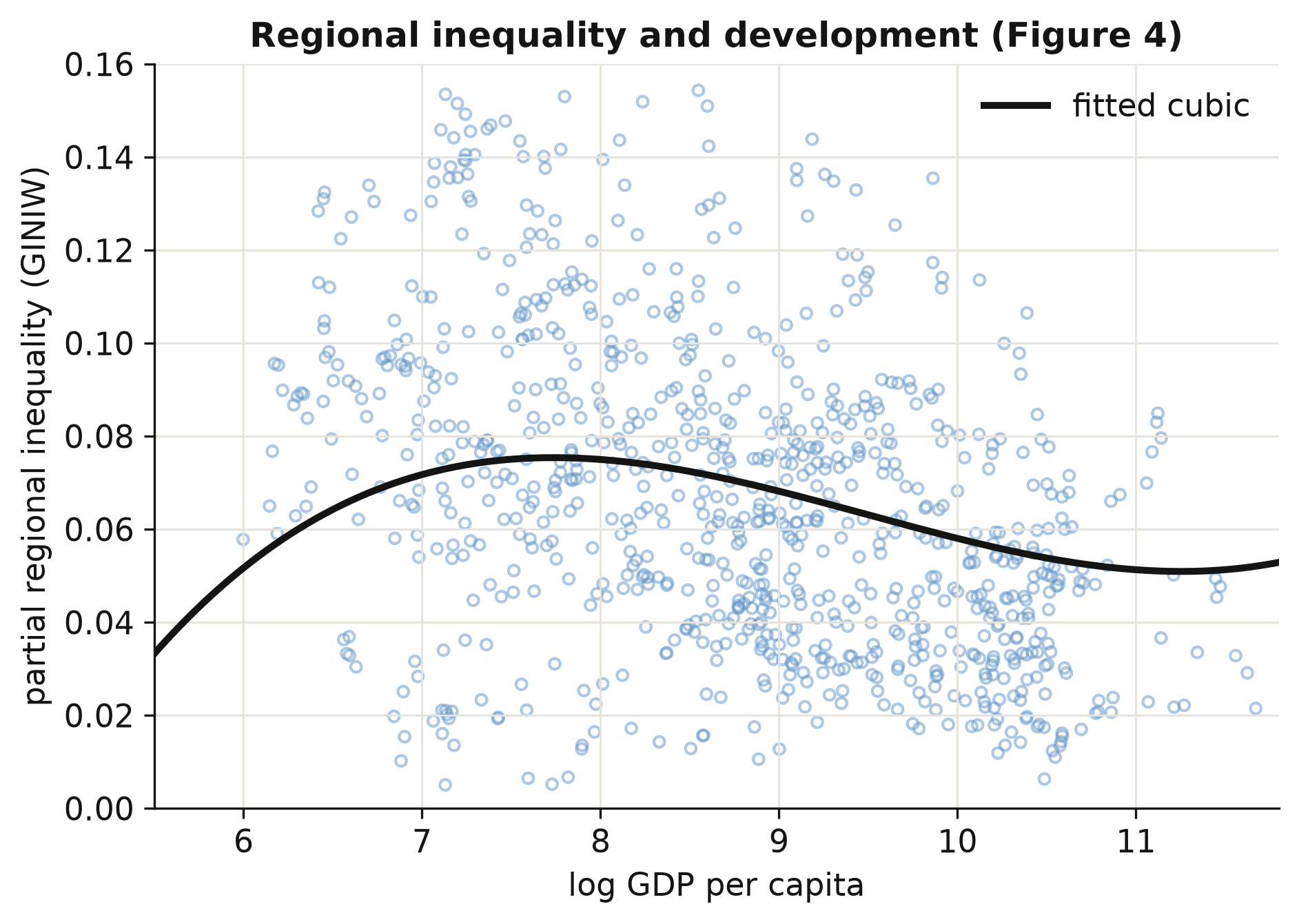
Reading the figure: the fitted curve rises to a gentle peak around a log income of 8 (roughly \$3,000 per capita), declines through the middle-income range, and flattens — with a barely perceptible uptick — at the very top, tracing the N-shape the coefficients implied. Each circle is one country in one 5-year period, net of period effects, so the vertical spread that remains is genuine country-to-country variation in inequality at a given income level. That the cloud is wide is the honest takeaway: development explains the shape of regional inequality, but a great deal is left over — and naming those leftover drivers is exactly what the determinants in Section 10 set out to do.
9. Turning points and the discriminant test
The cubic in §8 can bend twice — but does it actually, and does it bend inside the range of incomes we observe? This section answers both, and it is the most transferable skill in the post: any time you fit a cubic, these two checks tell you whether the curve really has the shape its coefficients seem to promise. The same two-step test is developed on a synthetic panel in the R companion post r_kuznets; here we apply it to the lights-based regional Gini.
9.1 Calculating the turning points
Where does the curve change direction? At a turning point the slope is zero, so we set the derivative of the cubic to zero:
$$\frac{\partial \text{GINIW}}{\partial \ln Y} = \beta_1 + 2\beta_2 \ln Y + 3\beta_3 (\ln Y)^2 = 0.$$
This is a quadratic in $\ln Y$, so it has at most two roots — the inverted-U peak and the high-income trough. We solve it with the quadratic formula and exponentiate each root back into dollars:
b1, b2, b3 = m.coef()[["lg", "lg2", "lg3"]]        # 0.293 / -0.032 / 0.00112
D = b2**2 - 3*b1*b3                                 # the discriminant (see 9.2)
roots = np.sort([(-b2 - np.sqrt(D)) / (3*b3),
                 (-b2 + np.sqrt(D)) / (3*b3)])       # turning points, in ln Y
print("turning points: ln =", roots.round(2), "->  $", np.exp(roots).round(0))
turning points: ln = [ 7.74 11.25] -> $ [ 2287. 77206.]
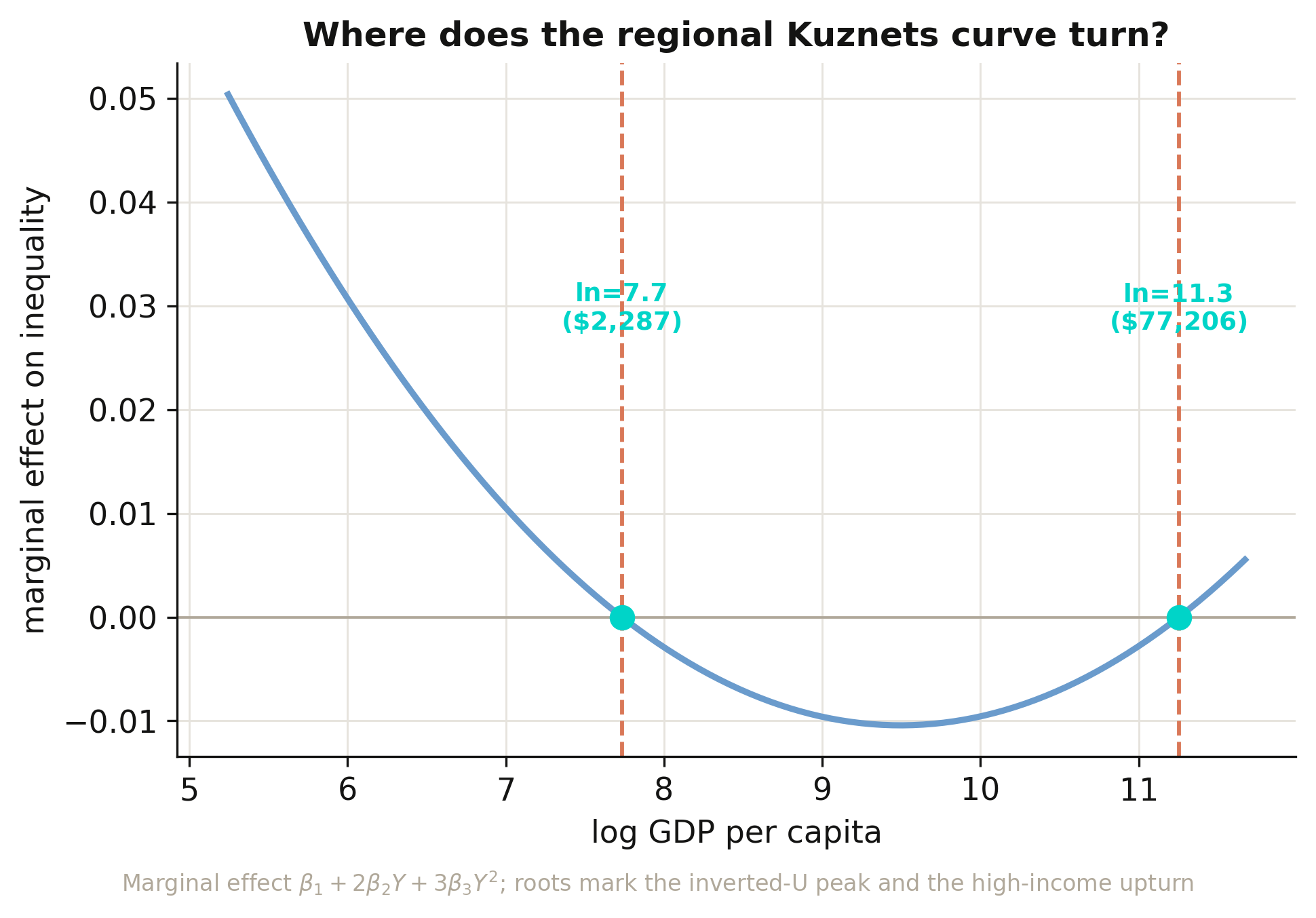
Regional inequality rises with development up to ln(GDP) ≈ 7.7 (about \$2,287), falls through the middle-income range until ln(GDP) ≈ 11.3 (about \$77,206), and then rises again. Interpretation 1: the first threshold marks the industrial take-off where a few leading regions surge ahead of the rest; the second marks the maturity where within-country convergence has run its course and post-industrial forces — services, finance, skilled-city agglomeration — begin to pull the richest regions apart again. Both turning points fall inside the observed income range (\$190–\$117,191), so this is a genuine N-shape rather than an extrapolation, and the two thresholds match the companion python_fe_kuznets post exactly. The figure plots the marginal effect (the derivative) rather than the curve itself, because the turning points are precisely where that line crosses zero.
9.2 The discriminant: does the curve really bend?
Solving for the roots numerically works, but it hides why a cubic sometimes has two turning points and sometimes none. The quadratic $\beta_1 + 2\beta_2 Y + 3\beta_3 Y^2 = 0$ has two real solutions exactly when its discriminant is positive. After dropping a harmless factor of 4 (algebra below), the rule collapses to a single number:
$$D \;\equiv\; \beta_2^2 - 3\,\beta_1\beta_3.$$
There are three regimes:
| Discriminant | Real turning points | Shape over the income line | Verdict |
|---|---|---|---|
| $D > 0$ | 2 | rise–fall–rise (an “N on its side”) | the cubic shape is real |
| $D = 0$ | 1 (inflection) | a single flat spot, no reversal | knife-edge boundary |
| $D < 0$ | 0 | monotonic — never reverses | the cubic shape is not real |
The textbook quadratic discriminant is $b^2 - 4ac = (2\beta_2)^2 - 4(3\beta_3)(\beta_1) = 4(\beta_2^2 - 3\beta_1\beta_3) = 4D$; the factor of 4 never changes the sign, so we work with the tidier $D = \beta_2^2 - 3\beta_1\beta_3$. For our cubic:
D = b2**2 - 3*b1*b3
print(f"D = {D:+.6f}  ->  {'two turning points' if D > 0 else 'monotonic'}")
D = +0.000035 -> two turning points
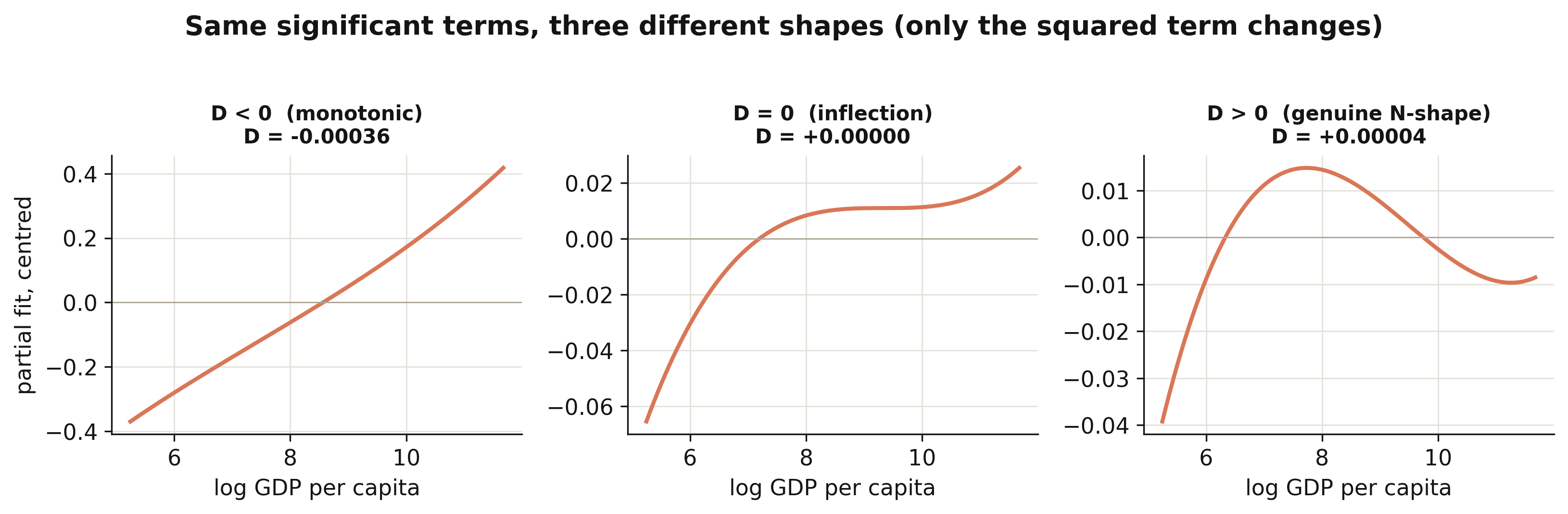
Interpretation 2: $D = +0.000035$ is positive, so the N-shape is real — but only just. The figure holds the linear and cubic terms at their fitted values and changes only the squared term: when $D<0$ the curve climbs monotonically, at $D=0$ it develops a single flat inflection, and once $D>0$ it bends into the genuine rise–fall–rise. Our cubic sits a hair above the $D=0$ knife-edge, so the third “act” — the post-\$77k upturn — is real but faint, exactly the “barely perceptible uptick” the §8 scatter showed. A slightly smaller squared term would erase it altogether.
9.3 Two checks, not one: significance is not shape
Here is the trap. All three income terms in our cubic are individually significant, and it is tempting to conclude “therefore the relationship is a genuine cubic with two turning points.” That inference is wrong as stated. Significance answers “does the data prefer keeping this term?”; it does not answer “does the fitted curve actually bend inside the income range we observe?” The discriminant — plus a check on where the turning points fall — answers the second question. Applying both checks to our cubic and to three illustrative cases makes the distinction concrete:
def diagnose(label, b1, b2, b3, lo, hi):
    D = b2**2 - 3*b1*b3
    if D <= 0:
        return dict(case=label, D=D, regime="monotonic (D<0)", in_range=False)
    tp = np.exp(np.sort([(-b2 - np.sqrt(D))/(3*b3), (-b2 + np.sqrt(D))/(3*b3)]))
    ok = bool((tp >= lo).all() and (tp <= hi).all())
    regime = "2 turning points " + ("(both in range)" if ok else "(>=1 OUT of range)")
    return dict(case=label, D=D, regime=regime, in_range=ok)

lo, hi = agg.GDP_pc_Country.min(), agg.GDP_pc_Country.max()
rows = [diagnose("This post's cubic (panel FE)",   b1,    b2,    b3,     lo, hi),
        diagnose("Synthetic A: genuine N-shape",    0.220, -0.026, 0.0010, lo, hi),
        diagnose("Synthetic B: monotonic trap",     0.220, -0.020, 0.0010, lo, hi),
        diagnose("Synthetic C: turns out of range", 0.220, -0.026, 0.0001, lo, hi)]
print(pd.DataFrame(rows).to_string(index=False))
                           case         D                              regime  in_range
   This post's cubic (panel FE)  0.000035    2 turning points (both in range)      True
   Synthetic A: genuine N-shape  0.000016    2 turning points (both in range)      True
    Synthetic B: monotonic trap -0.000260                     monotonic (D<0)     False
Synthetic C: turns out of range  0.000610 2 turning points (>=1 OUT of range)     False
Read the rows from top to bottom:
- This post’s cubic — $D = +0.000035 > 0$ and both turning points (\$2,287 and \$77,206) fall inside the observed range (\$190–\$117,191). Significance and shape agree: a genuine, if marginal, N-shape.
- Synthetic A — the same sign pattern with a clean $D>0$ and both turning points in range. This is what an unambiguous N-shape looks like.
- Synthetic B (the trap) — the same signs as a real N-shape, only the squared term is a touch smaller in magnitude, and $D = -0.00026 < 0$. The curve is monotonic everywhere. A cubic regression on such data could report all three terms as “significant” and still have no turning point at all.
- Synthetic C — $D>0$, so two turning points exist mathematically, but the tiny cubic term throws the upper one to an astronomical income far outside any real economy. Inside the observed range the curve never reverses. “Two turning points exist” would be technically true and practically misleading.
Interpretation 3: significance (does the data want the term?) and the discriminant-plus-range check (does the curve actually bend, and where?) are different questions, and you need both. Reporting “all three GDP terms are significant, so the curve is cubic” can fail in two distinct ways — the discriminant can be negative (B), or the turning points can fall outside the data (C). The honest workflow is: report the coefficients, compute $D$, and if $D>0$ confirm the turning points lie inside the observed income range before claiming an inverted-U or N-shape.
Aside (for Bayesian model averaging). The same trap reappears with a different label. In a BMA, a term’s posterior inclusion probability (PIP) near 1.00 is the Bayesian analogue of “statistically significant.” But a high PIP on the cubic term no more guarantees a genuine bend than a significant cubic coefficient does — you still compute $D = \beta_2^2 - 3\beta_1\beta_3$ from the posterior-mean coefficients and check the turning-point range. The R companion post r_kuznets works this analogy through with field data.
10. What drives regional inequality?
If two equally rich countries differ in regional inequality, what accounts for the gap? Following
the paper’s Table 4, we add blocks of structural determinants on top of the cubic — (1) a
baseline with the cubic alone, then (2) resources, (3) openness, (4) mobility/transport,
(5) institutions, (6) transfers and education, and (7) ethnicity — each with country and
period fixed effects and country-clustered standard errors. A positive coefficient means the factor
is associated with more regional inequality. The seven specifications go side by side in a
maketables regression table.
import maketables as mt
def det_fit(extra):                                # add a determinant block to the cubic
    return pf.feols(f"GINIW_pred_GDP_pc ~ lg+lg2+lg3 + {extra} | Country_ISO+p5",
                    data=agg4, vcov={"CRV1": "Country_ISO"})

d0     = pf.feols("GINIW_pred_GDP_pc ~ lg+lg2+lg3 | Country_ISO+p5",
                  data=agg4, vcov={"CRV1": "Country_ISO"})       # (0) baseline
d1     = det_fit("Resources_rents_share_of_GDP + Arable_land")   # (1) resources
d_inst = det_fit("Polity2 + lgXfed")                             # (4) institutions (lgXfed = log GDP × Federal)
d5     = det_fit("GINIW_Eth_light")                              # (6) ethnicity
# d2 openness, d3 mobility, d4 transfers+education are built the same way
mt.ETable([d0, d1, d2, d3, d_inst, d4, d5],
          model_heads=["baseline", "resources", "openness", "mobility",
                       "institutions", "transfers/edu", "ethnicity"],
          labels={"GINIW_pred_GDP_pc": "Population-weighted regional Gini", ...},
          coef_fmt="b:.3f* (se:.3f)", show_fe=True).make("html")
| Table 4. Determinants of regional inequality | |||||||
| Population-weighted regional Gini | |||||||
|---|---|---|---|---|---|---|---|
| baseline | resources | openness | mobility | institutions | transfers/edu | ethnicity | |
| (1) | (2) | (3) | (4) | (5) | (6) | (7) | |
| coef | |||||||
| log GDP p.c. | 0.293*** (0.078) | 0.350*** (0.075) | 0.205** (0.080) | 0.171** (0.078) | 0.277*** (0.060) | 0.226** (0.110) | 0.149** (0.059) |
| (log GDP p.c.)² | -0.032*** (0.009) | -0.038*** (0.009) | -0.022** (0.009) | -0.019** (0.009) | -0.030*** (0.007) | -0.023* (0.014) | -0.015** (0.007) |
| (log GDP p.c.)³ | 0.001*** (0.000) | 0.001*** (0.000) | 0.001** (0.000) | 0.001** (0.000) | 0.001*** (0.000) | 0.001 (0.001) | 0.000* (0.000) |
| Resource rents/GDP | 0.018*** (0.007) | ||||||
| Arable land | -0.053*** (0.014) | ||||||
| Trade/GDP | 0.005*** (0.002) | ||||||
| FDI/GDP | 0.009 (0.007) | ||||||
| Gasoline price | 0.001 (0.002) | ||||||
| Area × gasoline | 0.006** (0.003) | ||||||
| Polity2 | -0.001 (0.001) | ||||||
| log GDP × Federal | -0.001 (0.004) | ||||||
| Aid/GDP | 0.015** (0.007) | ||||||
| Schooling | -0.014* (0.007) | ||||||
| Ethnic inequality | 0.071*** (0.016) | ||||||
| fe | |||||||
| Country FE | x | x | x | x | x | x | x |
| Period FE | x | x | x | x | x | x | x |
| stats | |||||||
| Observations | 879 | 857 | 817 | 672 | 573 | 585 | 844 |
| R2 | 0.975 | 0.976 | 0.976 | 0.982 | 0.985 | 0.976 | 0.98 |
| Each column adds a block of determinants to the cubic in log GDP p.c. with country + 5-year-period FE; SEs clustered by country, in parentheses. The institutions column uses Polity2 and a log GDP × Federal interaction; the paper's ICRG bureaucratic-quality measure is licensed and omitted. * p<.1 ** p<.05 *** p<.01. | |||||||
The strongest determinant by far is ethnic inequality (column 7): 0.071 (p < 0.001) — countries where income differs sharply across ethnic homelands also have sharply unequal regions. Among the rest, resource rents push inequality up (0.018, p < 0.01) — resource wealth concentrates in a few regions — while a larger arable-land share pulls it down (−0.053, p < 0.001), consistent with agriculture spreading income more evenly; trade openness adds a small positive effect (0.005, p < 0.01) and aid relative to GDP a positive 0.015 (p < 0.05). The institutions column (5) is the one we can only partly reproduce: Polity2 and a log GDP × Federal interaction are both small and insignificant here, and the paper’s ICRG bureaucratic-quality index is licensed and omitted. The cubic in log GDP survives every block, and the sample drifts from column to column (N falls from 879 in the baseline to 573 where the sparse institutions variables bind), so the columns are best read as separate windows, not one nested model.
11. Spatial robustness: Conley standard errors
Regions are not independent: a boom in one province spills into its neighbours, so their regression errors are correlated. Ignoring that makes standard errors too small and t-statistics too big. We re-estimate the clean light elasticity (column 2, β = 0.190) and recompute its standard error allowing errors of regions within a chosen radius to be correlated — the Conley spatial-HAC correction — using a from-scratch implementation based on great-circle distances between region centroids.
m = pf.feols("log_GDP_pc_Region ~ log_Light_ppix_Region | code_Coutry_Region + satyear",
             data=dfb)                      # point estimate = 0.190
# Conley variance: weight cross-products of region scores by a Bartlett kernel
# k = max(0, 1 - distance / cutoff), distance = haversine great-circle km (see script.py)
for r in (1000, 2500, 5000):
    print(f"Conley SE @ {r} km = {np.sqrt(conley_var(r)):.3f}")
print(f"naive (iid) SE      = {m.se()['log_Light_ppix_Region']:.3f}")
Conley SE @ 1000 km = 0.026
Conley SE @ 2500 km = 0.034
Conley SE @ 5000 km = 0.037
naive (iid) SE      = 0.013
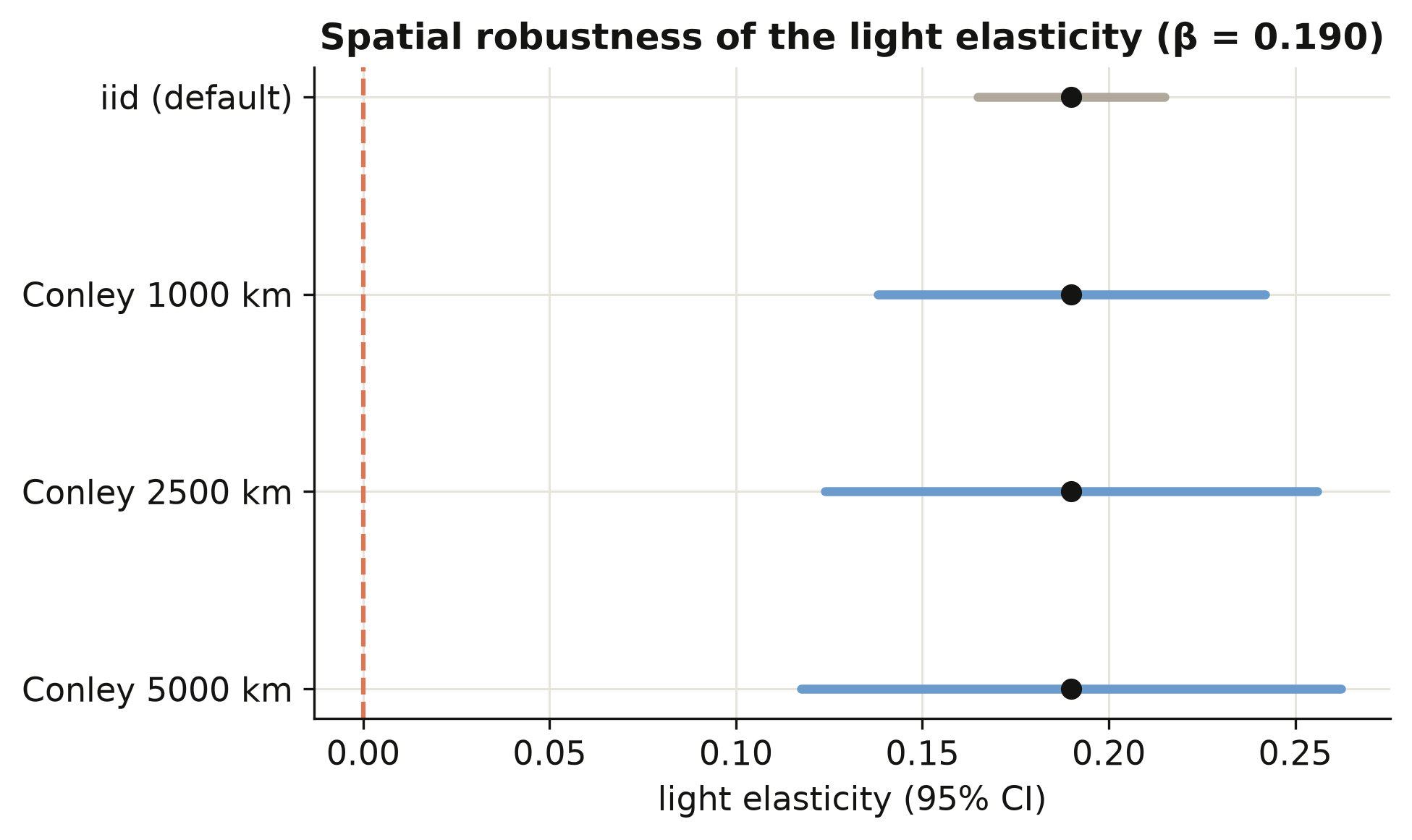
Allowing for spatial correlation roughly doubles to triples the standard error — from 0.013 to between 0.026 and 0.037 — because neighbouring regions are not the independent observations the naive formula assumes. Even so, the elasticity of 0.190 stays far from zero (a t-statistic above 5 at the widest radius), so the lights-predict-income relationship is not a statistical mirage created by ignoring geography. The figure shows the confidence interval widening with the radius while the point estimate holds fixed.
12. Regional versus personal inequality
A natural question: is regional inequality (gaps between places) just a reflection of personal inequality (gaps between people)? We compare each country’s regional Gini with its household-income Gini, both averaged over 2001–2012, and fit a line. A positive slope means the two inequalities go together.
slope, intercept = np.polyfit(agg5["GINIW_pred_GDP_pc"], agg5["GINIall_100"], 1)
print(f"n = {len(agg5)} countries | OLS slope = {slope:.3f}")
n = 144 countries | OLS slope = 0.587
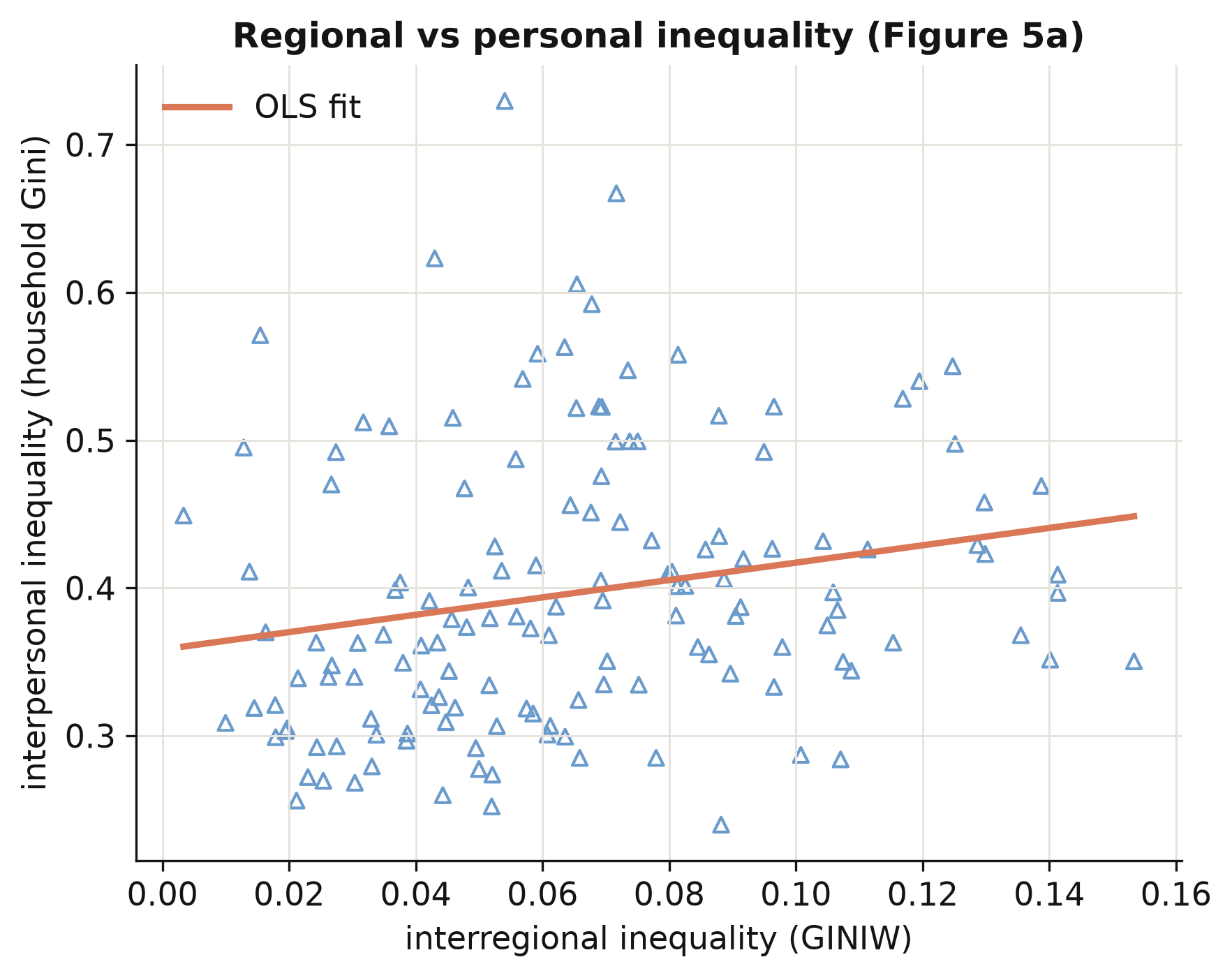
Across 144 countries the household-income Gini rises with the regional Gini at a slope of 0.587: places with wide gaps between regions also tend to have wide gaps between people. Regional and personal inequality are distinct but linked — so policies that narrow the gap between a country’s regions are also, in part, distributional policies between its citizens. This connects the satellite-based regional measure back to the inequality people actually experience.
13. Discussion
We set out to answer a measurement question — can we see inside countries from space? — and a substantive one — how does regional inequality move with development? The answer to the first is a qualified yes: a light-to-income elasticity of 0.102, predictions that correlate 0.925 with observed income, and inequality measures that track the observed data twice as well as raw light does. That is good enough to study regions that official statistics ignore, which is the whole point: the method turns a data desert into a global, comparable income map.
On the substantive question, regional inequality follows an N-shaped Kuznets path — rising through early development, falling as countries converge internally (the world average dropped from 0.070 to 0.061 over 1992–2012), with a faint upturn among the very richest. The single strongest correlate is ethnic inequality (0.071), a reminder that the internal economic geography of a country is bound up with its human geography. For a policymaker, the practical implication is concrete: the places where growth is failing to spread are now visible and measurable even without a statistical office, and the levers most associated with the gap — resource dependence, ethnic division — are nameable. Two cautions frame all of this. The relationships are descriptive associations with fixed effects, not causal effects; and the income figures are predictions, accurate on average but wrong for any single unusual region.
14. Summary and next steps
- Method insight. Nighttime lights predict regional income with an elasticity of 0.102 and a 0.925 correlation with observed income; predicting income first, rather than equating light with income, doubles the quality of the resulting inequality measures (Gini correlation 0.49 vs 0.21).
- Measurement insight. Population weighting is not cosmetic: weighted and unweighted Gini correlate only 0.75, and weighting lowers measured inequality by ~0.003 on average, so the weighting choice must be reported.
- Substantive insight. The regional Kuznets curve is N-shaped (cubic 0.293 / −0.032 / 0.001 across 180 countries), and ethnic inequality (0.071) is its strongest structural correlate.
- Robustness insight. The light elasticity of 0.190 survives spatial correlation — Conley standard errors of 0.026–0.037 are two to three times the naive 0.013, but the estimate stays far from zero.
- Limitation. Our from-scratch indices use only the ~1,500 regions with observed income; the published series uses every region on Earth (correlation 0.88), which is why the full paper predicts income globally.
- Next steps. Swap in a modern lights product (VIIRS replacing DMSP) to extend the series past 2012; or carry the full-world prediction through to rebuild the global income map and the choropleth figures we skipped here.
15. Exercises
- Re-weight the world. Modify
ineq_indicesto weight regions by land area instead of population, recompute the regional Gini for every country, and compare the cross-country ranking to the population-weighted one. Which countries move most, and why? - A fourth act? Re-estimate the Kuznets cubic on the coefficient of variation
(
COVW_pred_GDP_pc) instead of the Gini, and add a quartic term (lg4). Does the upturn at high income strengthen, vanish, or stay a rounding error? - How far do shocks travel? Recompute the Conley standard error at radii of 250, 500, and 10,000 km. Plot the standard error against the radius. At what distance does spatial correlation stop mattering for the light elasticity?
16. References
- Lessmann, C., & Seidel, A. (2017). Regional inequality, convergence, and its determinants — A view from outer space. European Economic Review, 92, 110–132.
- Henderson, J. V., Storeygard, A., & Weil, D. N. (2012). Measuring economic growth from outer space. American Economic Review, 102(2), 994–1028.
- Gennaioli, N., La Porta, R., Lopez-de-Silanes, F., & Shleifer, A. (2014). Growth in regions. Journal of Economic Growth, 19(3), 259–309.
- Kuznets, S. (1955). Economic growth and income inequality. American Economic Review, 45(1), 1–28.
- Conley, T. G. (1999). GMM estimation with cross sectional dependence. Journal of Econometrics, 92(1), 1–45.
- PyFixest — fast fixed-effects estimation in Python (documentation)
- linearmodels — panel data models in Python (documentation)
- Mendez, C. (2026). The spatial Kuznets curve in R: turning points and the discriminant test (companion post, synthetic replication of Lessmann 2013).
- Mendez, C. (2026). Regional inequality and the Kuznets curve: panel fixed effects in Python (companion post).
Original data sources
- Hodler, R., & Raschky, P. A. (2014). Regional favoritism. Quarterly Journal of Economics, 129(2), 995–1033.
- Alesina, A., Michalopoulos, S., & Papaioannou, E. (2016). Ethnic inequality. Journal of Political Economy, 124(2), 428–488.
- Weidmann, N. B., Rød, J. K., & Cederman, L.-E. (2010). Representing ethnic groups in space: A new dataset (GREG). Journal of Peace Research, 47(4), 491–499.
- NOAA / National Geophysical Data Center — DMSP-OLS Nighttime Lights (Version 4 “stable lights”).
- GADM — Database of Global Administrative Areas.
- CIESIN — Gridded Population of the World (GPW), v3.
- World Bank — World Development Indicators (WDI).
- Central Intelligence Agency — The World Factbook.
- Center for Systemic Peace — Polity IV Annual Time-Series.
Appendix A. Data dictionary
This appendix documents every column in all six data files: what it is, how it was originally
constructed, its source, its units, and its time–country coverage. Coverage is written as
years · units · N, where N is the number of non-missing observations and units counts the
distinct countries (country files) or regions (region files) with data. Definitions follow Lessmann
and Seidel (2017) and the official variable labels in the authors’ replication archive; coverage and
statistics are computed in script.py.
A.1 The six datasets in detail
All six files are tidy panels. The region files are keyed by region × year over the
1,504-region / 81-country training frame (1992–2010); the country files are keyed by
Country_ISO × year over 180 countries (1992–2012). The inequality indices in the country files are
built from the predicted regional incomes in the region files.
| File | Unit | Rows × Cols | Years | Countries | Regions | What it is for |
|---|---|---|---|---|---|---|
Prediction_Data.csv | region-year | 5,258 × 30 | 1992–2010 | 81 | 1,504 | Train the light→income model (Table 1) |
Table_2_data.csv | region-year | 5,258 × 8 | 1992–2010 | 81 | 1,504* | Validate the inequality indices (Table 2) |
Table_3_data.csv | country-year | 3,675 × 9 | 1992–2012 | 180 | — | Kuznets curve: GDP + 5 indices (Table 3) |
Table_4_data.csv | country-year | 3,675 × 17 | 1992–2012 | 180 | — | Determinants of inequality (Table 4) |
Table_B4_data.csv | region-year | 5,258 × 14 | 1992–2010 | 81 | 1,504 | Conley spatial-HAC errors (+ lat/lon) |
Figure_5_data.csv | country-year | 3,675 × 5 | 1992–2012 | 180 | — | Regional vs personal inequality |
* Table_2_data.csv has no explicit region-id column, but its rows are the same 1,504-region
training frame at region-year.
A.2 Variable dictionary
Coverage shorthand: region-frame variables are 1992–2010 · 1,504 reg (81 ctry) · N = 5,258 unless noted; core country-frame variables are 1992–2012 · 180 ctry · N = 3,675 unless noted.
Identifiers and keys
| Variable | What it is | How constructed | Source | Unit | Coverage |
|---|---|---|---|---|---|
Country_ISO | Country code (ISO 3166-1) | Assigned per country | GADM | string | all files |
Country_NAME | Country name | — | GADM | string | all files |
Region_NAME | Region name | 1st-level admin-unit name | GADM | string | region frame |
code_Coutry_Region | Numeric region key (original spelling kept) | Region identifier | Authors | integer | region frame |
id_t_j | Country-year key | Concatenation of year + ISO (e.g. 2010CHE) | Authors | string | region frame |
year | Calendar year | — | — | year | per file (see A.1) |
Lights and income
| Variable | What it is | How constructed | Source | Unit | Coverage |
|---|---|---|---|---|---|
log_Light_ppix_Region | Log avg nighttime light per pixel | Region mean of DMSP-OLS stable-lights DN (0–63); +0.01 if zero, then log | NOAA/NGDC | log DN | region frame |
Light_Region | Regional total lights | Sum of pixel DN over the region | NOAA/NGDC | summed DN | 1992–2010 · 81 ctry · 5,258 (Table_2) |
Light_Country | Country total lights | Sum of pixel DN over the country | NOAA/NGDC | summed DN | 1992–2010 · 81 ctry · 5,258 (Table_2) |
GDP_pc_Region | Observed regional GDP per capita | Regional accounts, constant 2005 PPP US\$ | Gennaioli et al. (2014) | US\$ | region frame |
log_GDP_pc_Region | Log of GDP_pc_Region | Natural log | Gennaioli et al. (2014) | log US\$ | region frame |
pred_GDP_pc_Region | Predicted regional GDP per capita | Fitted values of the eq.-1 RE model applied to all regions | This paper (model) | US\$ | 1992–2010 · 81 ctry · 5,258 (Table_2) |
GDP_pc_Country | National GDP per capita | constant 2005 PPP US\$ | World Bank WDI | US\$ | country frame |
log_GDP_pc_Country | Log national GDP per capita | Natural log | World Bank WDI | log US\$ | region frame |
Prediction-model regressors and fixed-effect dummies
| Variable | What it is | How constructed | Source | Unit | Coverage |
|---|---|---|---|---|---|
log_N_pix_top_cod_1_ppix | Log # top-coded pixels (DN = 63) | Count of saturated pixels per region, logged | NOAA/NGDC | log count | region frame |
log_N_pix_low_cod_1_ppix | Log # low-coded pixels (DN = 0) | Count of dark pixels per region, logged | NOAA/NGDC | log count | region frame |
log_area | Log region area | Region polygon area, logged | GADM | log km² | region frame |
log_region | Log # regions in the country | Count of regions per country, logged | GADM / Gennaioli | log count | region frame |
log_region_X_log_area | Interaction term | log_region × log_area | Derived | — | region frame |
eap, eca, lac, mena, sa, ssa | World-Bank region-group dummies | 1 if the country is in that group (North America = reference) | World Bank | 0/1 | region frame |
satyear_1 … satyear_7 | Satellite-configuration dummies | 1 per satellite/sensor era (sensors change and age over time) | NOAA/NGDC | 0/1 | region frame |
Population and geography
| Variable | What it is | How constructed | Source | Unit | Coverage |
|---|---|---|---|---|---|
Pop_Region | Regional total population | Population density × region area, rounded up (min 1); 5-yr waves interpolated to annual | GPW v3 (CIESIN) | persons | region frame |
Pop_Country | Country total population | Sum of regional populations | GPW v3 (CIESIN) | persons | region & country frames |
area | Country land area | Total land area (excl. inland water) | World Bank WDI | km² | country frame |
Latitude, Longitude | Region centroid coordinates | Polygon centroid | GADM | degrees | region frame (Table_B4) |
Inequality indices (all population-weighted, on predicted regional income)
| Variable | What it is | How constructed | Source | Unit | Coverage |
|---|---|---|---|---|---|
GINIW_pred_GDP_pc | Regional Gini | Population-weighted Gini of pred_GDP_pc_Region within a country-year | This paper | 0–1 | country frame |
COVW_pred_GDP_pc | Regional coefficient of variation | Population-weighted CV | This paper | ≥ 0 | country frame |
GE_1W_pred_GDP_pc | Theil index, GE(1) | Population-weighted GE(α = 1) | This paper | ≥ 0 | country frame |
GE_0W_pred_GDP_pc | Mean log deviation, GE(0) | Population-weighted GE(α = 0) | This paper | ≥ 0 | country frame |
GE_m1W_pred_GDP_pc | GE(−1) | Population-weighted GE(α = −1) | This paper | ≥ 0 | country frame |
Giniall | National interpersonal income Gini | Household-survey income Gini (0–100 scale) | Lessmann & Seidel (2017) | 0–100 | 1992–2012 · 153 ctry · 1,330 (Figure_5) |
Determinants (country frame, 1992–2012)
| Variable | What it is | How constructed | Source | Unit | Coverage |
|---|---|---|---|---|---|
Resources_rents_share_of_GDP | Natural-resource rents | Oil + gas + coal + mineral + forest rents, % of GDP | World Bank WDI | % GDP | 177 ctry · N = 3,620 |
Arable_land | Arable-land share | Arable land as a share of land area (FAO definition) | World Bank WDI | share | 178 ctry · N = 3,603 |
Trade_GDP_share | Trade openness | (Exports + imports) / GDP | World Bank WDI | ratio | 176 ctry · N = 3,509 |
FDI_share_of_GDP | FDI openness | Net FDI inflows / GDP | World Bank WDI | ratio | 174 ctry · N = 3,477 |
price_gasoline | Gasoline pump price | Pump price, PPP constant 2005 US\$/litre (the paper’s “transport cost” = area × price) | World Bank WDI | US\$/L | 162 ctry · N = 1,366 |
Aid | Aid flows | Net aid received, constant 2011 US\$ | World Bank WDI | US\$ | 155 ctry · N = 2,964 |
School_enrollment_secondary | Secondary-school enrolment | Gross secondary enrolment ratio | World Bank WDI | % gross | 172 ctry · N = 2,566 |
GINIW_Eth_light | Ethnic inequality | Population-weighted light-Gini across ethnic homelands (method of Alesina et al. 2016) | NOAA/NGDC + GREG (Weidmann et al. 2010) | 0–1 | 173 ctry · N = 3,528 |
Polity2 | Democracy–autocracy score | Polity IV combined score, rescaled −1 (autocracy) to +1 (democracy) | Center for Systemic Peace, Polity IV | −1…+1 | 157 ctry · N = 3,158 |
fedelupd2 | Federalism dummy | 1 if the country is federally organised | Authors | 0/1 | 1992–2009 · 154 ctry · N = 2,724 |
The authors’ Table 4 also uses an ICRG “bureaucratic quality” index, which is licensed and not redistributed in this bundle; the post therefore omits that one determinant column.
Appendix B. Stata replication
Everything in the main body was done in Python, stitched together from several libraries —
pandas for the data, pyfixest for fixed effects, linearmodels for random effects,
statsmodels for the Kuznets plot, and a hand-written function for the inequality indices. This
appendix shows the same study in Stata, where the whole thing is far shorter. The reason is
that Stata ships the heavy machinery as built-in commands: the entire prediction model is one
xtreg … , re line, all five inequality indices come from one ineqdeco call, and the cubic
Kuznets curve plus its graph are three lines (xtreg, margins, marginsplot). Fewer
keystrokes, identical numbers.
The code below loads the bundled Stata datasets — the .dta files described in
Appendix A, which carry their variable labels with them, so Stata’s
output is self-documenting. The full, runnable script is the Stata do-file linked at the top of
this post (stata_replication.do); the blocks here are excerpts. Install the two helper packages
once:
* Run once per machine. outreg2 is optional (formatted tables); ineqdeco does Section B.4.
ssc install outreg2
ssc install ineqdeco
Each subsection below maps to a numbered section of the post, and every figure it quotes matches the Python result in the main body.
B.1 Setup and the data (§3–§4)
use reads a native .dta straight from the bundle — no column-type guessing as with a CSV — and
xtset declares the panel (the region is the unit, the year is time). That one line is all the
panel commands need afterwards.
* --- Step 1: load the region-year training panel and declare the panel -----
use "Prediction_Data.dta", clear     // labels travel with the file
describe                              // already a mini data dictionary
xtset code_Coutry_Region year         // panel = region x year
B.2 Cross-country dynamics (§5)
The descriptive picture is a couple of one-liners. summarize gives the moments; correlate
reproduces the strong co-movement of the inequality indices reported in §5 — the regional Gini and
the Theil index correlate about 0.93.
* --- summary statistics and the index co-movement --------------------------
summarize log_GDP_pc_Region log_Light_ppix_Region log_GDP_pc_Country

use "Table_3_data.dta", clear                         // the country-year panel
correlate GINIW_pred_GDP_pc GE_1W_pred_GDP_pc COVW_pred_GDP_pc   // Gini–Theil ~ 0.927
B.3 Predicting GDP from nighttime lights — Table 1 (§6)
This is the centrepiece. We regress log regional GDP per capita on log nighttime light per pixel
across seven progressively richer specifications. In Stata each specification is one xtreg
line, and the estimator is chosen by a single option: re for random effects, fe for fixed
effects. robust cluster(Country_ISO) makes the standard errors robust and clustered by country
(this changes the standard errors, not the point estimate).
* --- Step 1: the seven-spec ladder (random effects, as in the paper) --------
use "Prediction_Data.dta", clear
xtset code_Coutry_Region year
xi i.code_Coutry_Region                 // region dummies for the OLS column (2)
set matsize 11000                        // room for ~1,500 region dummies

* (1) raw RE, no fixed effects
xtreg log_GDP_pc_Region log_Light_ppix_Region, re robust cluster(Country_ISO)
* (2) OLS with region + satellite FE -- the clean within-region elasticity
reg   log_GDP_pc_Region log_Light_ppix_Region _Icode_Cout_2-_Icode_Cout_1504 ///
      satyear_1-satyear_7, robust cluster(Country_ISO)
* (7) the PREDICTION model: + national income, geography, world-region & satellite FE
xtreg log_GDP_pc_Region log_Light_ppix_Region log_GDP_pc_Country ///
      log_N_pix_top_cod_1_ppix log_N_pix_low_cod_1_ppix log_area log_region ///
      log_region_X_log_area satyear_1-satyear_7 eap ssa mena lac eca sa, ///
      re robust cluster(Country_ISO)
The light elasticity climbs down the ladder — 0.399 → 0.190 → … → 0.102 at column 7 — and the national-income elasticity in column 7 is 0.889. These are exactly the random-effects numbers the post reports.
Fixed effects vs random effects — one word apart. The post devotes §6.3 to why the paper uses random effects; in Stata the contrast is a single option:
* --- Step 2: same specification, swap only the estimator -------------------
xtreg log_GDP_pc_Region log_Light_ppix_Region satyear_1-satyear_7, ///
      fe robust cluster(Country_ISO)         // within (FE):  0.190
xtreg log_GDP_pc_Region log_Light_ppix_Region satyear_1-satyear_7, ///
      re robust cluster(Country_ISO)         // random (RE):  0.190
At this simple specification FE and RE coincide at 0.190. They diverge once the full controls enter (the post’s within/FE estimate is 0.049 versus the random-effects 0.102): random effects keep the between-region signal that the within estimator discards. More importantly, only RE can predict for a region outside the sample — fixed effects have no intercept for an unseen region. That is the whole reason the paper publishes the random-effects model.
, fe (fixed effects) | , re (random effects — the paper) | |
|---|---|---|
| Uses which variation? | within-region only | within and between region |
| Predict for an unseen region? | no (no intercept for it) | yes — one shared model |
| Key assumption | none on the region effect | region effect uncorrelated with regressors |
Predicting. After the random-effects fit, predict , xb builds (design matrix) × (coefficients)
for every region in one line — the move fixed effects could not make — and exp() undoes the log.
* --- Step 3: predict, then back-transform to dollars, then validate --------
predict double pred_log_GDP_pc_Region, xb              // fitted log income
gen     double pred_GDP_pc_Region = exp(pred_log_GDP_pc_Region)   // back to dollars
correlate pred_log_GDP_pc_Region log_GDP_pc_Region     // -> 0.925
Predicted and observed log income correlate 0.925 across all 5,258 region-years — the same fit as the main body.
B.4 Constructing the inequality indicators — ineqdeco (§7)
This is the biggest single saving. The post writes a from-scratch function for the Gini, the three
generalized-entropy indices, and the coefficient of variation. Stata returns all of them from one
ineqdeco call, optionally population-weighted. After the command, r(gini) is the Gini,
r(gem1) is GE(−1), r(ge0) is the mean log deviation, r(ge1) is the Theil index, and the
coefficient of variation is $\sqrt{2 \times r(\text{ge2})}$.
* --- One country-year, to see all five numbers at once: Germany 2010 -------
use "Table_2_data.dta", clear            // region-year predicted income + population
ineqdeco pred_GDP_pc_Region [aw=Pop_Region] if Country_ISO=="DEU" & year==2010
display "Gini=" %5.4f r(gini) "  Theil=" %6.4f r(ge1) "  CV=" %5.4f sqrt(2*r(ge2))
For Germany in 2010 this returns Gini 0.0278, Theil 0.0016, CV 0.0565 — matching the worked example in §7.3. To build the whole country panel, loop once per country-year group and harvest the five returned scalars:
* --- Every country-year: one ineqdeco call per group, all five indices ------
egen _g = group(Country_ISO year)
quietly summarize _g, meanonly
local G = r(max)
foreach s in gini gem1 ge0 ge1 ge2 {                  // empty columns to fill
    gen double _idx_`s' = .
}
quietly forvalues i = 1/`G' {
    capture ineqdeco pred_GDP_pc_Region [aw=Pop_Region] if _g==`i'
    if _rc==0 {
        foreach s in gini gem1 ge0 ge1 ge2 {
            replace _idx_`s' = r(`s') if _g==`i'
        }
    }
}
rename _idx_gini GINIW_pred_GDP_pc                     // population-weighted regional Gini
gen double COVW_pred_GDP_pc = sqrt(_idx_ge2 * 2)
These rebuilt indices line up with the published ones at a correlation of about 0.879, the same validation the post reports in §7.5.
B.5 The regional Kuznets curve — Table 3 (§8)
Average each country to five 5-year periods, then regress the regional Gini on a cubic in log
national GDP per capita with country and period fixed effects. collapse does the averaging in one
line; xtreg … , fe does the within-country regression.
* --- Step 1: collapse annual data to 5-year period means --------------------
use "Table_3_data.dta", clear
gen p5year = .
replace p5year = 1 if inrange(year,1990,1994)
replace p5year = 2 if inrange(year,1995,1999)
replace p5year = 3 if inrange(year,2000,2004)
replace p5year = 4 if inrange(year,2005,2009)
replace p5year = 5 if inrange(year,2010,2014)
collapse (mean) GINIW_pred_GDP_pc GDP_pc_Country, by(Country_ISO p5year)

* --- Step 2: build the cubic and fit country + period fixed effects ---------
gen lg = log(GDP_pc_Country)
gen lg2 = lg^2
gen lg3 = lg^3
encode Country_ISO, generate(cid)
xtset cid p5year
xtreg GINIW_pred_GDP_pc lg lg2 lg3 i.p5year, fe robust cluster(cid)
The cubic coefficients are 0.293 / −0.032 / 0.0011 (N ≈ 879 country-periods, 180 countries) —
the same + / − / + sign pattern that traces the N-shaped spatial Kuznets curve in §8.
Drawing the curve (Figure 4) in two extra lines. Where the post refits a dummy model and
computes partial residuals by hand, Stata’s factor-variable notation c.lg##c.lg##c.lg builds the
cubic and tells margins that the three terms move together, so marginsplot bends the curve
correctly:
* --- Step 3: the fitted curve, the Stata way --------------------------------
xtreg GINIW_pred_GDP_pc c.lg##c.lg##c.lg i.p5year, fe robust cluster(cid)
margins, at(lg=(5(0.5)12))
marginsplot, recast(line) recastci(rarea) ///
    title("Regional Kuznets curve") xtitle("log GDP per capita") ///
    ytitle("Predicted regional Gini")
B.6 Turning points and the discriminant (§9)
A cubic turns where its slope is zero, i.e. where $3\beta_3,\ell^2 + 2\beta_2,\ell + \beta_1 = 0$.
Real turning points exist only if the discriminant $D = (2\beta_2)^2 - 4(3\beta_3)\beta_1$ is
positive. We read the three coefficients straight out of _b[] and solve the quadratic:
* --- turning points from the stored cubic coefficients ---------------------
scalar b1 = _b[lg]
scalar b2 = _b[lg2]
scalar b3 = _b[lg3]
scalar D  = (2*b2)^2 - 4*(3*b3)*b1                  // discriminant
scalar lo = (-2*b2 - sqrt(D)) / (2*3*b3)            // first turning point  (log)
scalar hi = (-2*b2 + sqrt(D)) / (2*3*b3)            // second turning point (log)
display "D=" D "   ln=" %4.2f lo " ($" %1.0f exp(lo) ")   ln=" %5.2f hi " ($" %1.0f exp(hi) ")"
The discriminant is positive ($D = +0.000035$), so there are two real turning points, at $\ell = 7.74$ (about \$2,287) and $\ell = 11.25$ (about \$77,206) — the same turning points as §9.
B.7 What drives regional inequality — Table 4 (§10)
The same 5-year panel and cubic as B.5, now adding a block of structural controls to each column. (Published column 4 needs a licensed ICRG variable that is not in the bundle, so it is omitted — as in the post.)
* --- determinants: keep the cubic, add one control block per column ---------
use "Table_4_data.dta", clear
* ... build p5year, collapse by(Country_ISO p5year), gen lg lg2 lg3, encode cid, xtset ...

* Natural-resource rents + arable land
xtreg GINIW_pred_GDP_pc lg lg2 lg3 Resources_rents_share_of_GDP Arable_land ///
      i.p5year, fe robust cluster(cid)
* Ethnic inequality (published column 6)
xtreg GINIW_pred_GDP_pc lg lg2 lg3 GINIW_Eth_light i.p5year, fe robust cluster(cid)
Resource rents enter positively (+0.018) and arable-land share negatively (−0.053); ethnic inequality carries a coefficient of 0.071 (N ≈ 844) — the headline determinant the post highlights in §10.
B.8 Spatial robustness: Conley standard errors — Table B.4 (§11)
This re-estimates the within-region lights model (Table 1, column 2) but replaces the standard errors with spatially-robust Conley/Hsiang errors at three cutoff radii. The point estimate does not move — only the standard errors.
A caveat on packages: ols_spatial_HAC is not on SSC. It is Solomon Hsiang’s ado (Hsiang 2010,
PNAS); copy ols_spatial_HAC.ado (and its helpers distance.ado, Tdiff.ado) into your personal
ado folder (type sysdir to find it). The region fixed effects enter as explicit dummies because
the command has no fe option.
* --- Conley spatial-HAC SEs at three radii (km) -----------------------------
use "Table_B4_data.dta", clear
tsset code_Coutry_Region year
xi i.code_Coutry_Region                  // region FE as explicit dummies
set matsize 11000
gen const = 1                            // the command needs an explicit constant

foreach D in 1000 2500 5000 {            // spatial-correlation cutoff radius
    ols_spatial_HAC log_GDP_pc_Region log_Light_ppix_Region ///
        _Icode_Cout_2-_Icode_Cout_1504 satyear_1-satyear_7 const, ///
        lat(Latitude) lon(Longitude) t(year) p(code_Coutry_Region) ///
        dist(`D') lag(0) bartlett
}
The coefficient is 0.190 in all three columns. The Stata Conley standard errors widen with the radius (about 0.020 / 0.025 / 0.027); the post’s Python Conley errors (0.026 / 0.034 / 0.037) are a touch larger because the two packages weight distances slightly differently. Either way the conclusion is identical: the light elasticity is not an artefact of spatial correlation — the naïve iid standard error is only about 0.013.
B.9 Regional versus personal inequality — Figure 5 (§12)
Finally, does inequality between regions track inequality between people? Average each country over 2001–2012, put both Ginis on the same 0–1 scale, and regress one on the other.
* --- cross-country regression of personal on regional inequality -----------
use "Figure_5_data.dta", clear
keep if year>2000 & year<2013
collapse (mean) GINIW_pred_GDP_pc Giniall, by(Country_ISO)
gen GINIall_100 = Giniall/100                  // household Gini 0-100 -> 0-1
regress GINIall_100 GINIW_pred_GDP_pc          // slope = 0.587 over n ~ 144
twoway (scatter GINIall_100 GINIW_pred_GDP_pc, msymbol(t)) ///
       (lfit    GINIall_100 GINIW_pred_GDP_pc), legend(off) ///
       xtitle("Interregional inequality (GINIW)") ///
       ytitle("Interpersonal inequality (Gini)")
Across 144 countries the slope is 0.587: places with wide gaps between regions also tend to have wide gaps between people — the same link the post finds in §12.
B.10 The same study, far fewer lines
Side by side, the contrast is the point of this appendix:
| Task | Python (main body) | Stata (this appendix) |
|---|---|---|
| Prediction model | linearmodels.RandomEffects + a design-matrix helper | xtreg … , re (one line) |
| Five inequality indices | a hand-written function | ineqdeco … (one call) |
| Kuznets curve + plot | statsmodels refit + partial residuals | xtreg + margins + marginsplot (three lines) |
| Fixed ↔ random effects | two different libraries | swap fe ↔ re |
Every headline number above — the 0.102 light elasticity, the 0.925 prediction correlation,
the 0.293 / −0.032 / 0.0011 cubic, the 0.071 ethnic-inequality coefficient, the 0.587
regional-versus-personal slope — reproduces the Python result in the main body. The complete,
runnable script is the stata_replication.do linked at the top of this post.

Carlos Mendez
Associate Professor of Development Economics
My research interests focus on the integration of development economics, spatial data science, and econometrics to better understand and inform the process of sustainable development across regions.