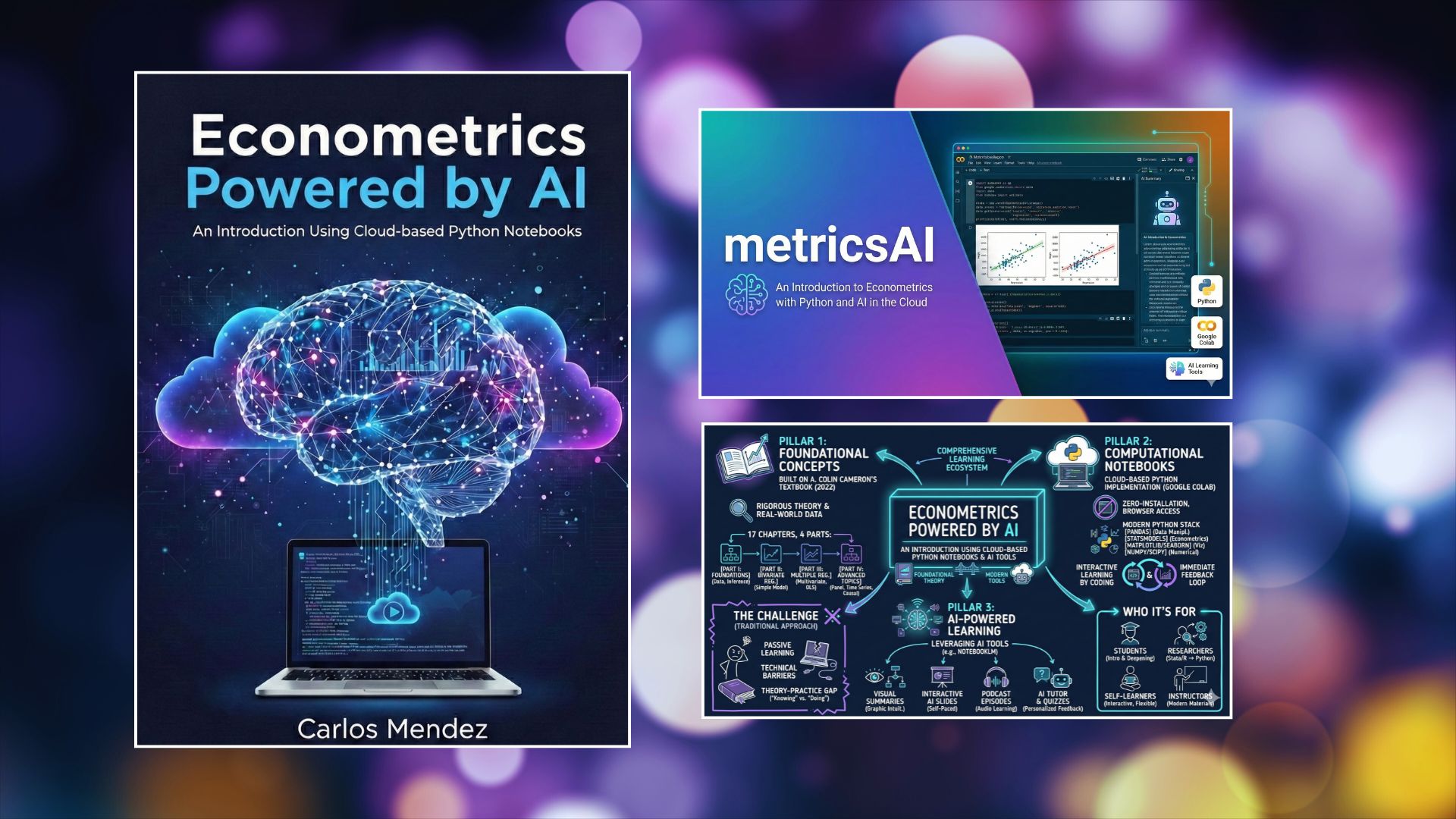
Econometrics powered by AI
Abstract
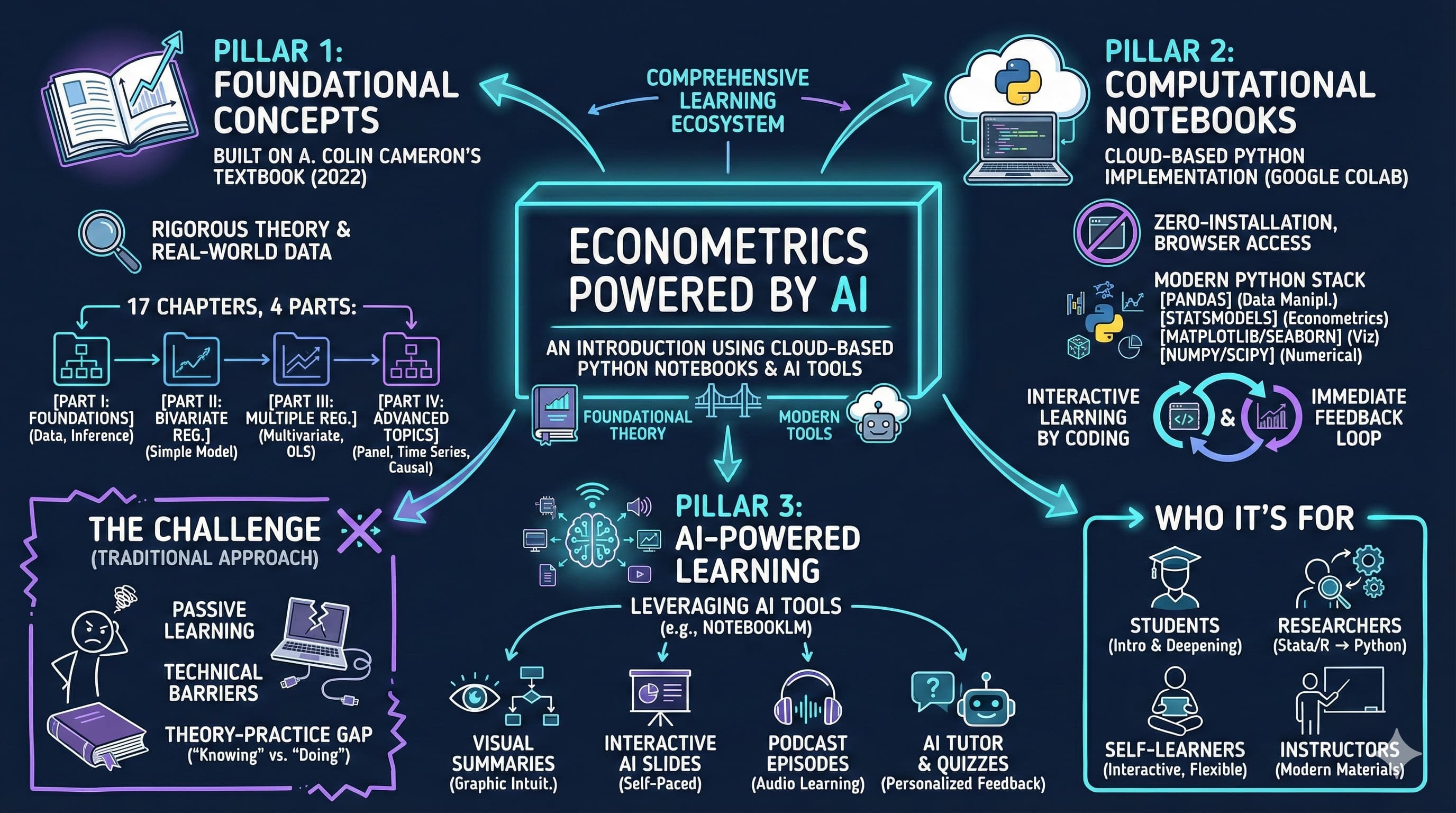
This book and its related website introduce a modern approach to econometrics education that integrates theoretical foundations with cloud-based computation and AI-enhanced learning tools. Designed as a computational companion to A. Colin Cameron’s ‘Analysis of Economics Data: An Introduction to Econometrics’, it addresses persistent challenges in learning econometrics—passive textbook engagement, technical barriers, and the gap between theory and implementation—by combining three pillars: foundational econometric concepts, interactive Python notebooks accessible through a zero-installation cloud environment, and AI-powered learning resources. Across seventeen chapters spanning statistical foundations to advanced topics such as panel data and causal inference, learners work hands-on with real data using modern Python libraries while remaining grounded in established statistical and econometric theory. Visual summaries, slides, quizzes, podcasts, videos and AI tutors provide multimodal reinforcement and personalized feedback, supporting diverse learning styles. Together, these elements form a comprehensive learning ecosystem that reimagines how econometrics can be taught and learned in the era of cloud computing and artificial intelligence.
🤖 Econometrics Powered by AI
An Introduction Using Cloud-based Python Notebooks
🚀 Vision
- 🤖 Econometrics in the AI era
- ☁️ Cloud-based, interactive learning
- 📊 Real data, real economic questions
Learning econometrics is reframed as an active, computational, and AI-supported process that preserves theoretical rigor.
🧠 Why Rethink Econometrics Education?
- 📖 Passive textbooks
- 💻 High technical barriers
- 🔗 Gap between theory and implementation
Traditional approaches often delay meaningful data analysis and hinder conceptual understanding.
🔄 The Book’s Approach
- 🧱 Foundational concepts
- 🧪 Computational notebooks
- 🤖 AI-powered learning
A three-pillar system integrates theory, coding, and AI to create an active learning ecosystem.
📘 Pillar 1: Foundational Concepts
- 📚 Based on Cameron (2022)
- 📐 Rigorous econometric theory
- 🌍 Applied, real-world focus
The structure and content align with standard econometric practice and research.
🗂️ Structure
- 🧮 Statistical foundations
- 📉 Bivariate regression
- 📊 Multiple regression
- 🔬 Advanced topics
Seventeen chapters progress systematically from fundamentals to modern empirical methods.
☁️ Pillar 2: Computational Notebooks
- 🚫 Zero installation
- 🧑💻 Google Colab
- 🌐 Access from any device
Every chapter is paired with an interactive Python notebook.
🧰 Modern Python Stack
- 🐼 Data manipulation
- 📐 Econometric modeling
- 📊 Visualization
Students learn widely used, transferable tools for empirical research.
🔁 Learning by Coding
- ✏️ Modify and rerun code
- ⚡ Immediate feedback
- 🔍 Active experimentation
Understanding develops through direct interaction with data and models.
🤖 Pillar 3: AI-Powered Learning
- 🖼️ Visual summaries
- 📑 AI-generated slides
- 🎙️ Podcasts and quizzes
Multiple modalities reinforce learning and accommodate diverse preferences.
⚖️ Responsible AI Use
- 🧠 AI supports, not replaces, thinking
- 🔍 Verification is essential
- 📘 Theory remains central
AI enhances understanding but does not substitute for econometric reasoning.
🔗 Three-Component Learning System
- 📕 This book
- 🌐 metricsAI website
- 📘 Cameron’s textbook
Together, they form a complete and coherent learning environment.
🎓 Conclusion
- 📊 Econometrics through computation
- 🤖 Enhanced by AI
- 🌍 Accessible and rigorous

Carlos Mendez
Associate Professor of Development Economics
My research interests focus on the integration of development economics, spatial data science, and econometrics to better understand and inform the process of sustainable development across regions.