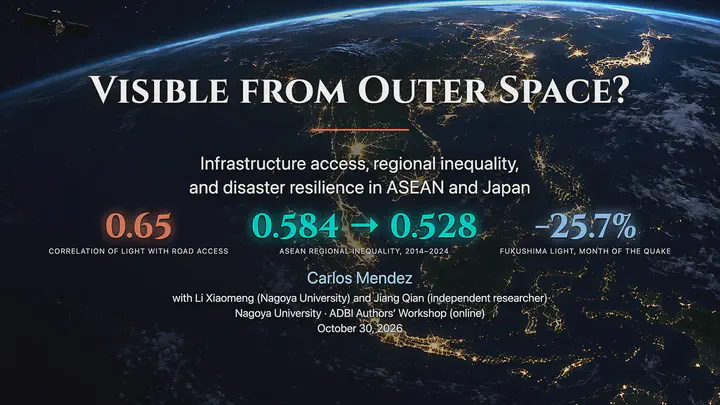
Visible from Outer Space? Infrastructure, Regional Inequality, and Disaster Resilience
Abstract
Infrastructure needs assessments in Southeast Asia are costly, infrequent, and stop at the national border. This study evaluates nighttime lights as an annual, subnational measure of infrastructure across 325 first-level regions of the ASEAN member states and Japan over 2014–2024. Because the VIIRS satellite passes overhead at about 01:30, the light it records comes mainly from installed infrastructure rather than from economic activity. First, the measure agrees with satellite-based Sustainable Development Goal indicators of access to roads, public transport, and open space that are built without nighttime lights. Second, regional inequality in luminosity across ASEAN declined while average brightness rose, whereas inequality across Japanese prefectures remained lower and stable. Third, synthetic control estimates show that nighttime lights record the 2011 Great East Japan Earthquake in Fukushima, Miyagi, and Iwate, and that the shortfall in light persists after official output statistics no longer show it. Nighttime lights therefore offer a low-cost tool to monitor access to infrastructure, its regional inequality, and its recovery from disasters.

Carlos Mendez
Associate Professor of Development Economics
My research interests focus on the integration of development economics, spatial data science, and econometrics to better understand and inform the process of sustainable development across regions.